

Key Focus This Week:
“Big Tech Earnings, Canadian Consumer Trends and Energy Risks Take Center Stage”
Following last week’s heavy schedule of U.S. inflation releases, the Bank of Canada’s interest rate decision, and Federal Reserve Chair Kevin Warsh’s congressional testimony, the macroeconomic calendar becomes relatively lighter this week. Investor attention is expected to shift toward corporate earnings, Canadian consumer spending trends, policy signals from the European Central Bank (ECB), and ongoing geopolitical developments in the Middle East. With energy prices once again emerging as a key driver of inflation expectations and bond market movements, corporate earnings will face increased scrutiny as investors assess whether current valuations remain justified.
In Canada, the latest inflation report indicated that overall price pressures continued to moderate, largely due to lower energy costs, while several core inflation measures also showed signs of easing. However, with crude oil prices rebounding in recent weeks, the sustainability of this disinflationary trend remains uncertain.
Meanwhile, Canada will release its latest retail sales report this week. After the Bank of Canada left its policy rate unchanged last week and acknowledged that domestic economic conditions are gradually improving, investors will closely examine consumer spending data to determine whether household demand is stabilizing. Resilient retail sales would reinforce expectations of a gradual economic recovery, while continued weakness in consumer spending could renew concerns over Canada’s growth outlook amid elevated living costs and persistent economic uncertainty.
In the United States, the lighter macroeconomic calendar means that corporate earnings are likely to become the primary driver of equity market performance. Alphabet, Tesla and IBM will report quarterly results this week, followed by Intel. After the recent correction in artificial intelligence and semiconductor-related equities, investors will focus on whether corporate earnings and forward guidance remain strong enough to justify elevated growth expectations.
Technology will once again remain the market’s primary focus. Investors will assess corporate results for signs of continued investment in AI infrastructure, cloud computing demand, semiconductor industry fundamentals, and developments in the electric vehicle market. Even companies delivering relatively solid operating performance have recently received cautious market reactions, suggesting that investors are becoming increasingly selective toward high-valuation growth stocks. Should earnings or guidance fail to meet elevated expectations, volatility within the technology sector is likely to remain elevated.
The European Central Bank will also hold its monetary policy meeting this week. Following its previous policy tightening in response to inflationary pressures stemming from higher energy prices and geopolitical tensions, markets will closely monitor how policymakers reassess the balance between rising energy costs and slowing economic growth. Beyond the interest rate decision itself, the ECB’s forward guidance regarding inflation risks and the future policy path is expected to have a broader impact on European bond markets, the euro, and global risk assets.
Meanwhile, geopolitical developments in the Middle East remain one of the most significant sources of uncertainty for global financial markets. Military tensions between the United States and Iran continue, disruptions to energy shipments through the Strait of Hormuz remain a concern, and Yemen’s Houthi forces have expanded threats against commercial shipping, further increasing global energy supply risks. At the same time, renewed diplomatic efforts toward a ceasefire have partially eased market concerns.
As a result, crude oil prices are likely to remain highly volatile this week, fluctuating between supply disruption risks and optimism surrounding diplomatic negotiations. For Canada, higher oil prices generally provide support for energy and resource-related equities. However, if elevated energy prices reignite inflationary pressures, they could also reduce the scope for future monetary easing and weigh on interest-rate-sensitive sectors such as real estate, consumer discretionary and other domestic cyclical industries.
Week’s Key Economic Data & News Recap
U.S. Inflation Shows Signs of Moderation, While the Federal Reserve Remains Cautious
Last week’s U.S. Consumer Price Index (CPI) and Producer Price Index (PPI) both indicated that inflationary pressures continued to ease, largely driven by declining energy prices. The moderation temporarily reduced market concerns over further monetary tightening and prompted investors to reassess the expected path of future interest rates.
Nevertheless, inflation risks have not disappeared. Renewed geopolitical tensions in the Middle East have pushed energy prices higher, raising concerns that recent progress on inflation may prove temporary. Meanwhile, Federal Reserve Chair Kevin Warsh, during his first semiannual monetary policy testimony before Congress, reiterated the Fed’s commitment to restoring price stability while refraining from providing explicit guidance on the timing of future policy adjustments.
Overall, last week’s data suggest that inflation has moderated in the near term, but the Federal Reserve continues to monitor energy prices, consumer demand and broader inflation trends closely. Under current conditions, a single month’s data are unlikely to materially alter the central bank’s policy trajectory.
Bank of Canada Holds Rates Steady While Expressing Greater Confidence in the Economic Outlook
The Bank of Canada left its policy rate unchanged last week. Policymakers acknowledged that although economic activity had previously been relatively soft, recent indicators suggest that conditions are gradually improving, with economic growth expected to strengthen over time. The Bank also indicated that inflationary pressures are likely to continue moderating.
However, the Bank emphasized that considerable uncertainty remains. Rising energy prices associated with geopolitical tensions in the Middle East, together with evolving U.S. trade policies, continue to pose risks to Canada’s inflation outlook, exports and business investment. As a result, policymakers maintained a data-dependent approach and avoided providing explicit guidance regarding future policy moves.
Overall, the Bank of Canada’s assessment of the domestic economy has become somewhat more constructive, although policymakers remain cautious regarding external risks and the possibility of renewed inflationary pressures.
Resilient U.S. Consumer Spending Offsets Economic Concerns, While Technology Stocks Weigh on Equity Markets
Last week’s U.S. retail sales report showed that consumer spending remained relatively resilient despite persistent pressure from higher energy prices and elevated living costs. The data suggested that household demand continues to support the U.S. economy, helping alleviate concerns over a sharp economic slowdown.
However, U.S. equity markets faced renewed pressure as semiconductor and artificial intelligence-related stocks led a broad technology sector pullback. After months of strong gains, investors began reassessing whether AI-driven investment enthusiasm would ultimately translate into earnings growth sufficient to justify current valuations. Although early second-quarter earnings results were generally solid, investor expectations for future growth and corporate guidance have become increasingly demanding.
The market’s recent performance suggests that investors remain constructive on the long-term AI investment theme, but have become significantly more valuation-sensitive. As more major technology companies report earnings this week, their results may play a decisive role in determining the market’s near-term direction.
Middle East Tensions Push Oil Higher While Gold Remains Constrained by Interest Rate Expectations
Geopolitical tensions escalated further last week as military conflict between the United States and Iran intensified, while concerns surrounding shipping security in the Strait of Hormuz and the Red Sea continued to increase. These developments drove crude oil prices sharply higher, making energy supply risks once again a key market focus. Energy equities outperformed, while broader equity markets faced renewed pressure from rising inflation expectations and interest rate concerns.
Higher oil prices also altered the performance dynamics of other asset classes. Although geopolitical uncertainty typically increases safe-haven demand for gold, investors became increasingly concerned that rising energy prices could reignite inflationary pressures and force major central banks to maintain restrictive monetary policies for longer. As a result, higher interest rate expectations offset part of gold’s traditional safe-haven appeal, leaving precious metals under pressure throughout the week.
Looking ahead, energy markets remain heavily influenced by both military developments and ongoing diplomatic negotiations. Until greater clarity emerges regarding the Middle East, elevated volatility across crude oil, sovereign bond yields and precious metals is likely to persist.
Investing with an AimStar's investment professional
Want expert advice at every step of your investing journey?
AimStar’s investment professionals can set you on the right course – and they can meet in-person or online.

Market Performance Review – Last Week
Source: Yahoo Finance
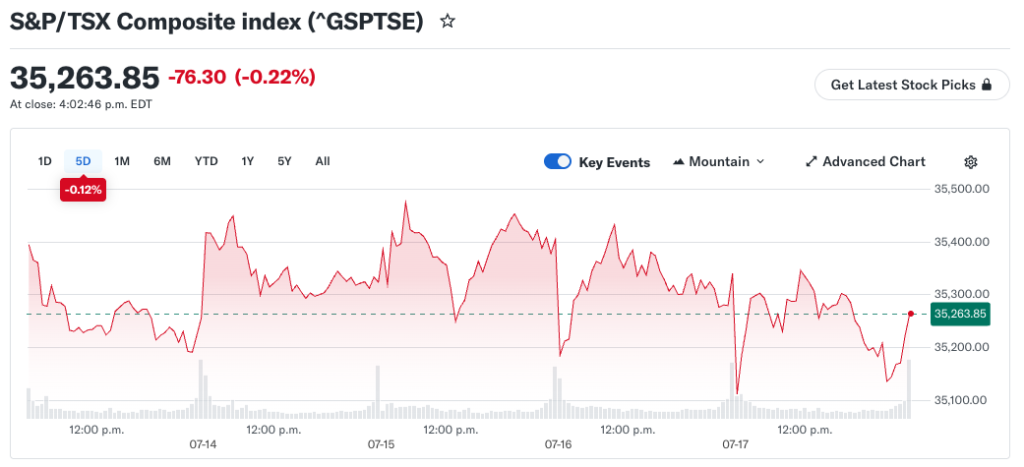
Canadian Equities:
Last week, the S&P/TSX Composite Index traded within a range of approximately 35,030.00 to 35,500.00. The index declined approximately 0.12% over the five-day period, closing at 35,263.90.
Source: Yahoo Finance
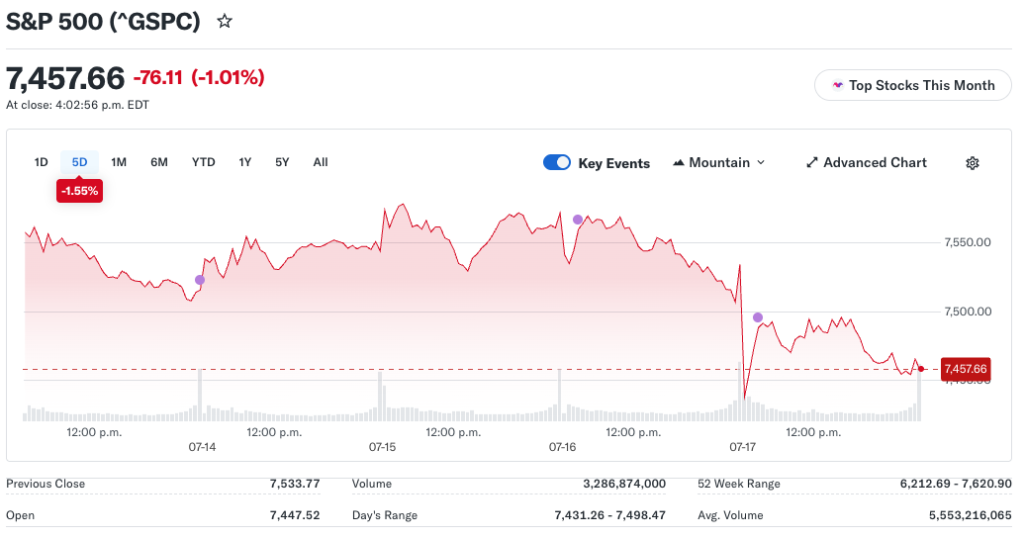
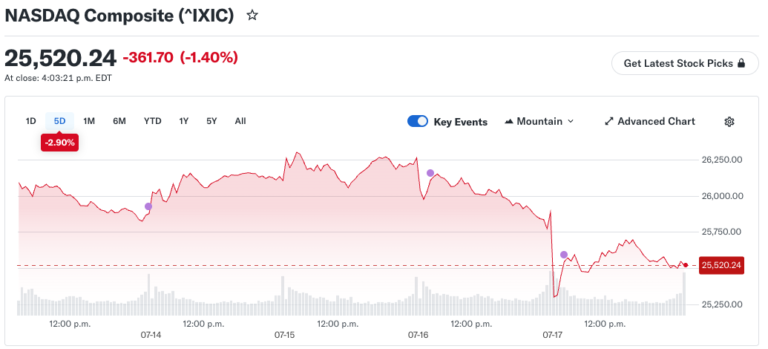
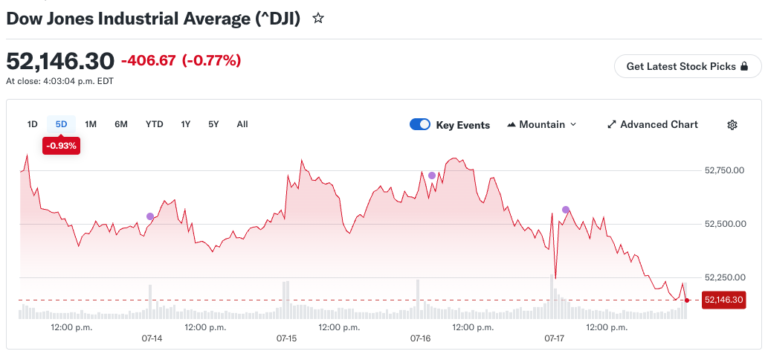
U.S. Equities:
Last week, the three major U.S. equity indices traded lower overall. The S&P 500 Index traded within a range of approximately 7,430.00 to 7,580.00, declining 1.55% over the five-day period to close at 7,457.69. The NASDAQ Composite Index traded between 25,250.00 and 26,290.00, falling 2.90% over the week to close at 25,520.24, with weakness primarily driven by a pullback in semiconductor and large-cap technology stocks. Meanwhile, the Dow Jones Industrial Average traded within a range of 52,140.00 to 52,820.00, declining 0.93% over the five-day period to close at 52,146.42.
Source: Yahoo Finance
U.S. Bonds:
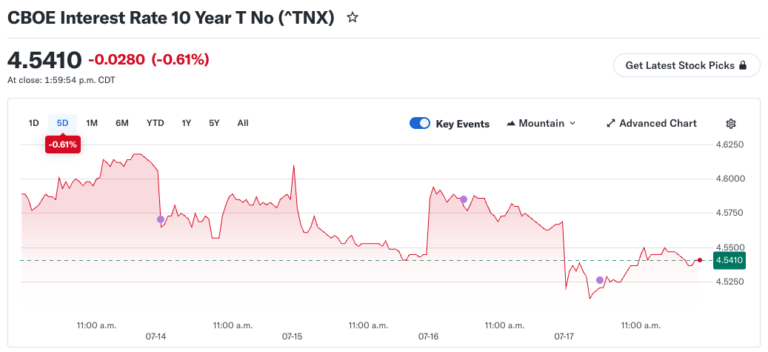
Last week, the U.S. 10-Year Treasury Yield traded within a range of approximately 4.52% to 4.61%, declining 0.61% over the five-day period to close at 4.541%. The yield briefly rose above 4.60% early in the week, primarily driven by higher-than-expected U.S. inflation data and market expectations that the Federal Reserve would maintain interest rates at elevated levels.
Source: Yahoo Finance
Forex Market:
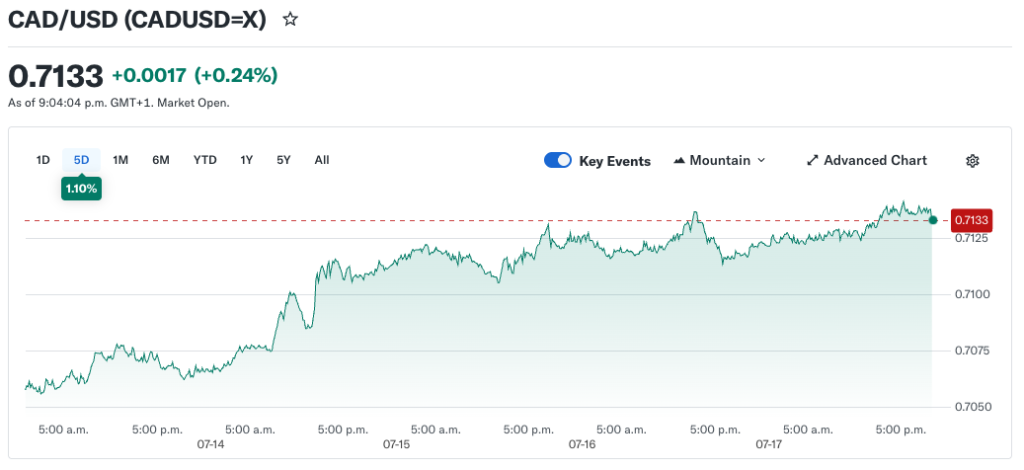
Last week, the CAD/USD exchange rate traded within a range of approximately 0.7050 to 0.7135, gaining 1.10% over the five-day period to close at 0.7133. The Canadian dollar continued to strengthen, supported by the Bank of Canada’s relatively hawkish policy stance, resilient employment data and a weaker U.S. dollar. The exchange rate moved above 0.7130 later in the week, reaching its highest level in several months.
Source: Yahoo Finance
Gold & Silver Market:
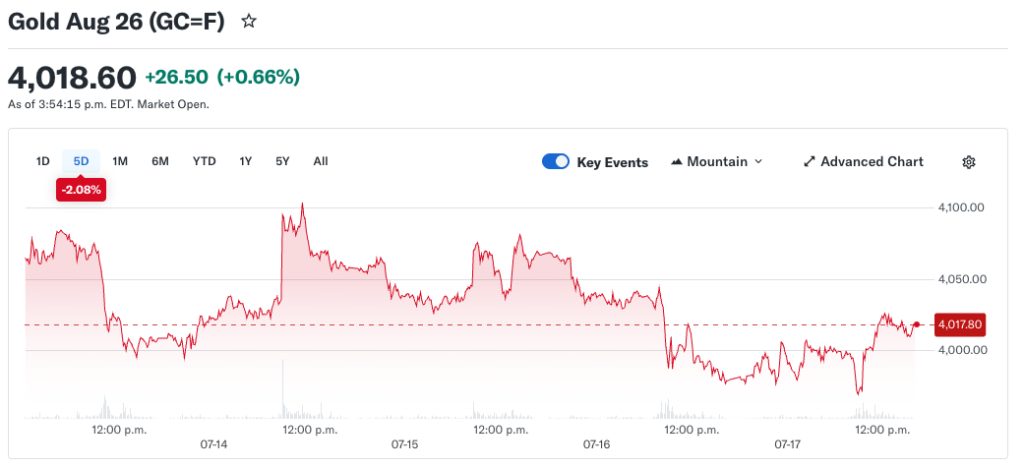
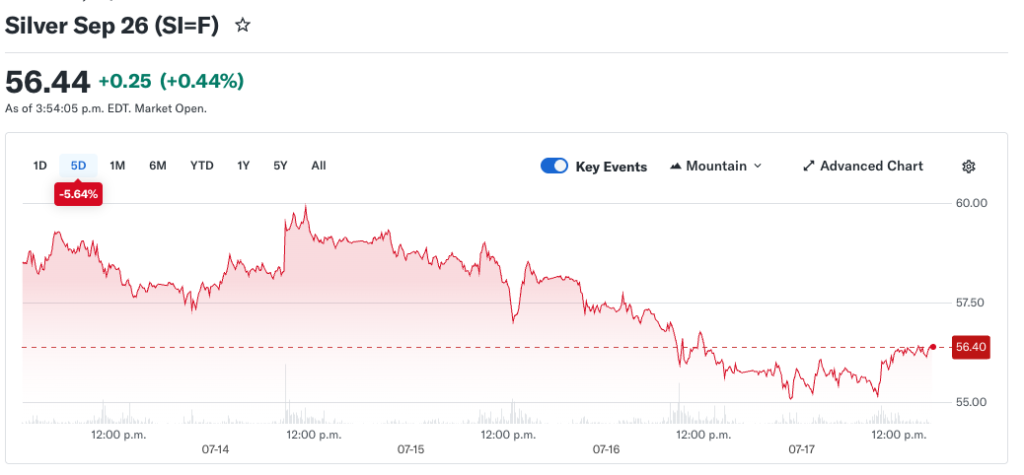
Last week, Gold Futures traded within a range of approximately 3,970.00 to 4,105.00, declining 2.08% over the five-day period to close at 4,012.70. Silver Futures traded between 55.00 and 60.00, falling 5.64% over the week to close at 56.04. Precious metals came under broad pressure as U.S. June inflation data exceeded market expectations, expectations that the Federal Reserve would maintain interest rates at elevated levels increased, and the U.S. dollar remained relatively strong. However, gold and silver staged a technical rebound from their weekly lows later in the week as U.S. Treasury yields declined and safe-haven demand strengthened, although both still recorded weekly losses.
Source: Yahoo Finance
Oil Market:
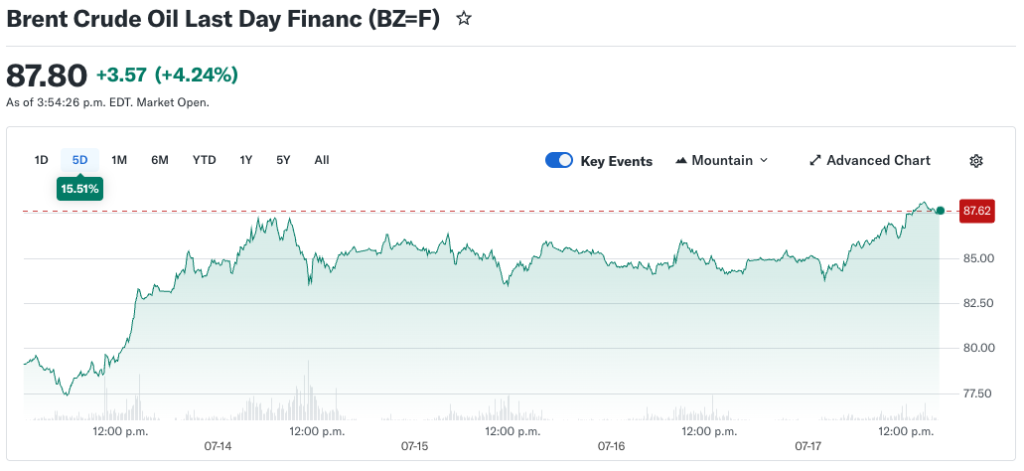
Last week, Brent Crude Futures traded within a range of approximately US$77.20 to US$88.20 per barrel, gaining 15.51% over the five-day period to close at US$88.10 per barrel. International oil prices rose sharply amid continued geopolitical tensions in the Middle East, growing concerns over the security of crude oil shipments through the Strait of Hormuz, and an increase in the risk premium associated with potential supply disruptions.
- Let us contact you
Investing with an AimStar's investment professional
Want expert advice at every step of your investing journey?
AimStar’s investment professionals can set you on the right course – and they can meet in-person or online.
Financial Market Data Copyright © 2026 AimStar myportfolio. Data as of July 20th, 2026, 12:30 PM EST

WHAT'S HAPPENING THIS WEEK

Upcoming Events (July 20 – July 24, 2026)
July 20 (Monday)
- Before Market Open: AMC Entertainment, Domino’s Pizza, Ryanair, SmartBank, AGNC Investment and Monarch Casino report earnings.
- After Market Close: Crown Holdings, BOK Financial, Steel Dynamics, W.R. Berkley, Zions Bancorporation, Calix and Wintrust Financial report earnings.
July 21 (Tuesday)
- Before Market Open: Halliburton, Vicor, Ally Financial, D.R. Horton, Danaher, Charles Schwab, 3M, Valmont Industries and MSCI report earnings.
- After Market Close: Alaska Air Group, East West Bancorp, Annaly Capital Management, American Airlines, Equitable Holdings, Range Resources, Western Alliance Bancorporation and Pegasystems report earnings.
July 22 (Wednesday)
- Before Market Open: GE Vernova, AT&T, Travel + Leisure, Wabtec, TE Connectivity, PulteGroup, Iridium Communications, Moody’s and First BanCorp report earnings.
- After Market Close: Tesla, Alphabet (Google), ServiceNow, IBM, Texas Instruments, Kinder Morgan, SL Green Realty, Crown Castle and CSX report earnings.
July 23 (Thursday)
- Before Market Open: Nokia, Cleveland-Cliffs, American Airlines, Huntington Bancshares, STMicroelectronics, The Interpublic Group, Cemex, Lockheed Martin and Tractor Supply report earnings.
- After Market Close: Intel, MaxLinear, Deckers Brands, Newmont, Columbia Banking System, Boyd Gaming, Sallie Mae, Boston Beer, RingCentral and JAKKS Pacific report earnings.
July 24 (Friday)
- Before Market Open: Verizon, Charter Communications, American Express, NextEra Energy, Canadian National Railway (CN), Booz Allen Hamilton, Lowe’s Companies, SLB (Schlumberger), HCA Healthcare and Central Pacific Financial report earnings.
Author by: Sarah San
Edited & Published by: Sarah San
July 20th , 2026 13:00 PM EST. 10 min read

AimStar Capital Group Inc. is a Canadian full-service Investment Dealer, regulated by Canadian Investment Regulatory Organization (CIRO) and a member of Canadian Investor Protection Fund (CIPF). As an independent firm, AimStar is built on a foundation of innovation, integrity, and client-centricity. They are committed to providing unbiased advice and dedicated to the client’s needs, helping them achieve their financial goals.
AimStar is recognized as a Wealth Professionals 5-star Wealth Management Firm for 2024, this award recognized AimStar has offered exceptional client experience, a proven investment track record, continuous innovation, and stringent regulatory compliance.