

Key Focus This Week:
This Week’s Focus: Fed Decision, Canadian Inflation and Economic Growth Momentum
Federal Reserve policy will be a key focus for global financial markets this week. The Fed is scheduled to announce its interest rate decision and updated economic projections on September 16. Investors will closely watch any rate adjustment, the updated dot plot and the Chair’s guidance on the policy path ahead. The policy signals could trigger repricing in U.S. Treasury yields and the U.S. dollar, with implications for equity valuations and global capital flows.
In Canada, the August CPI release on September 14 and the Bank of Canada’s meeting summary on September 16 will help markets assess the inflation trend and the outlook for interest rates. Investors will focus on how the central bank balances price pressures, economic growth and trade uncertainty. Shifts in relative U.S. and Canadian policy expectations could also influence the Canadian dollar and domestic bond markets.
On the economic data front, U.S. August retail sales, housing starts and industrial production will be released during the week, providing further insight into the strength of consumer spending, housing and manufacturing activity. With household living costs and financing pressures still in focus, the extent to which these data show resilient demand could shape expectations for economic growth and corporate earnings.
Meanwhile, energy transportation risks in the Middle East remain important to monitor. A regional meeting originally scheduled to take place in Oman on September 14 has been postponed, while developments affecting shipping through the Strait of Hormuz and related diplomatic efforts could continue to drive oil-price volatility. Changes in energy prices have implications not only for global inflation expectations, but also for the performance of Canada’s energy sector and corporate input costs.
Last Week’s Key Economic Data & News Recap
U.S. Inflation Data Reinforce Expectations for a Fed Rate Hike
U.S. PPI rose 5.4% year over year in August, while CPI increased 3.4%. Although core CPI eased to 2.4% year over year, the 0.3% monthly increase came in above market expectations, prompting investors to further price in the possibility of a Federal Reserve rate hike in September. Persistent inflation pressures and a tighter rate outlook continued to affect U.S. Treasury yields, corporate financing costs and equity valuations.
Rising Middle East Energy-Transport Risks Add to Global Inflation Pressures
Following an attack on a major Saudi oil pipeline, the route was shut down as a precaution, while shipping volumes through the Bab el-Mandeb Strait declined significantly. These developments heightened concerns over potential disruptions to crude-oil supply. Although signs of diplomatic easing on Friday helped oil prices retreat, transportation risks remain. For the United States and Canada, elevated energy prices could raise transportation and production costs, while providing support to revenues for Canadian energy producers.
U.S. Consumer Sentiment Weakens, Raising Questions About the Consumption Outlook
The preliminary University of Michigan Consumer Sentiment Index for September fell to 47.8 from 51.7, while one-year inflation expectations rose to 4.6% from 4.0%. Higher energy costs and trade uncertainty increased household concerns about purchasing power. The combination of weaker sentiment and rising inflation expectations has put greater focus on the sustainability of U.S. consumer spending and the earnings outlook for retail, services and other consumer-facing industries.
U.S.-Canada Trade Frictions Escalate, Pressuring Exports and Cross-Border Supply Chains
Following Canada’s retaliatory tariffs, the United States announced further potential countermeasures, including threats of import restrictions on Canadian dairy products and alcoholic beverages. The trade dispute has increased uncertainty around corporate procurement costs and export prospects, and could delay investment and disrupt cross-border supply chains. For Canadian markets, changes in trade policy remain an important factor shaping expectations for economic growth and corporate earnings.
Investing with an AimStar's investment professional
Want expert advice at every step of your investing journey?
AimStar’s investment professionals can set you on the right course – and they can meet in-person or online.

Market Performance Review – Last Week
Source: Yahoo Finance
Canadian Equities:
S&P/TSX Composite Index (^GSPTSE)
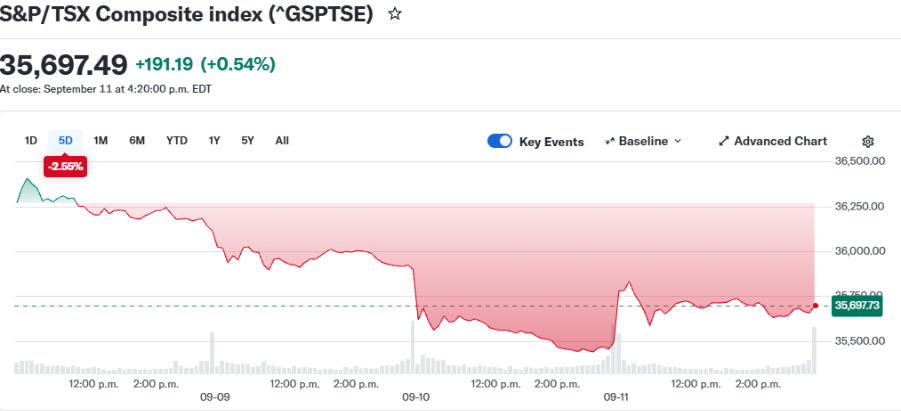
The S&P/TSX Composite Index traded lower overall during the week. After reaching a weekly high of 36,445.40 on September 8, the index declined in the following sessions and closed at 35,697.49 on September 11, down approximately 2.17% from September 4. Although the index rebounded 0.54% on Friday, the move was not enough to reverse the weekly decline, as energy-price volatility, higher interest rates and U.S.-Canada trade uncertainty weighed on market sentiment.
Source: Yahoo Finance
U.S. Equities:
S&P 500 Index (^GSPC)
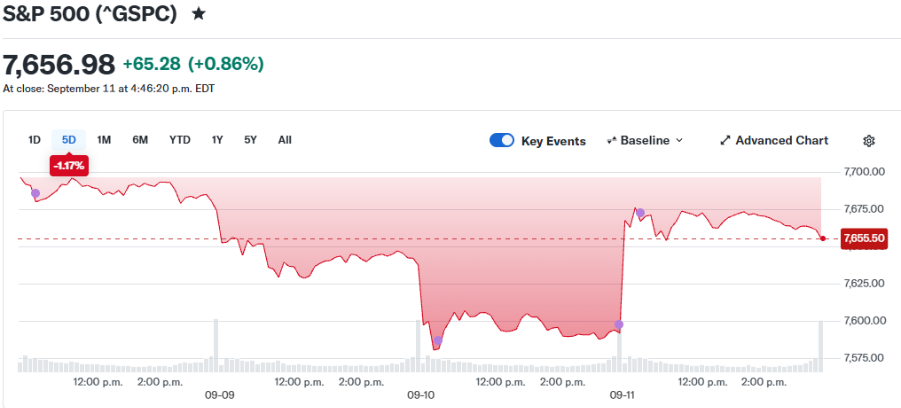
The S&P 500 was pressured mainly by inflation data and rising U.S. Treasury yields. The index reached a weekly high of 7,717.81 on September 8 before declining in subsequent sessions. It closed at 7,656.98 on September 11, down approximately 0.80% from September 4. Although the index rebounded around 0.86% on Friday, it did not fully recover earlier losses, ending its previous weekly advance and moving into a period of consolidation.
Nasdaq Composite Index (^IXIC)
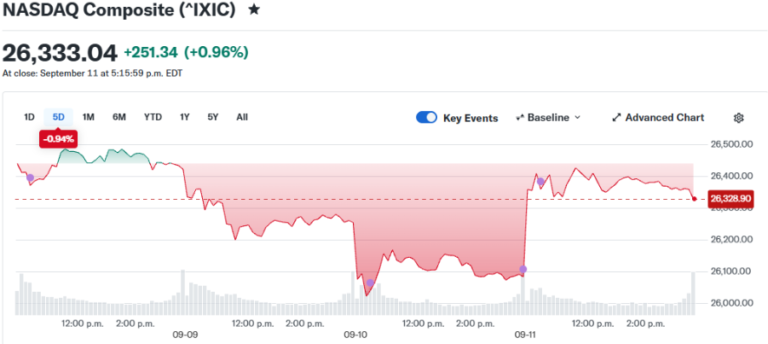
The Nasdaq Composite climbed to a weekly high of 26,542.14 on September 8 before retreating amid higher interest rates and valuation pressure on technology stocks. The index closed at 26,333.04 on September 11, down approximately 0.66% from September 4. A technology-led rebound of about 0.96% on Friday helped limit the weekly decline, leaving the Nasdaq relatively more resilient than the S&P 500 and the Dow.
Dow Jones Industrial Average (^DJI)
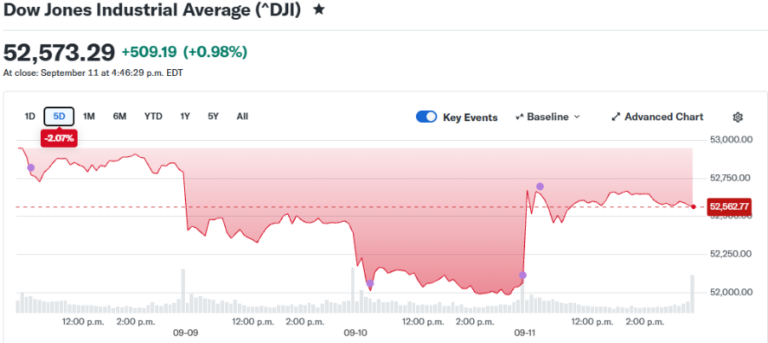
The Dow underperformed both the S&P 500 and the Nasdaq. After reaching a weekly high of 53,110.45 on September 8, the index declined in the following sessions. It closed at 52,573.29 on September 11, down approximately 1.57% from September 4. Despite a rebound of about 0.98% on Friday, weakness in industrials, healthcare and other cyclical heavyweight stocks left the Dow with the largest weekly decline among the three major U.S. equity indices.
Source: Yahoo Finance
U.S. Bonds:
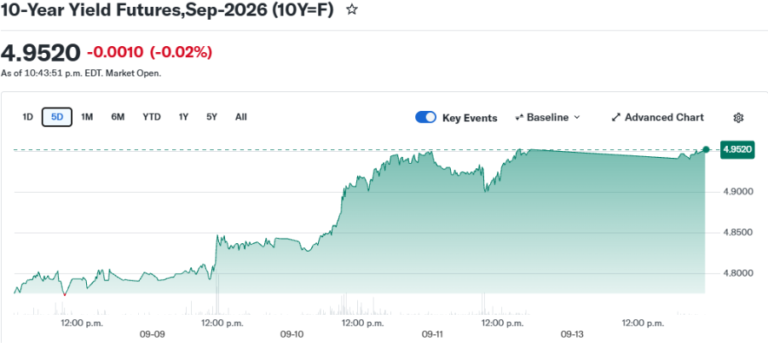
U.S. 10-Year Yield Futures (10Y=F)
The 10-year yield futures measure shown in the report moved notably higher, rising from approximately 4.782% on September 4 to about 4.953% on September 11, an increase of roughly 17.1 basis points. Over the same period, the yield on the benchmark 10-year U.S. Treasury note briefly approached 4.98%. The move was driven primarily by inflation concerns and expectations for a Federal Reserve rate hike. Higher yields imply lower Treasury prices and also increase valuation pressure on equities and borrowing costs for companies.
Source: Yahoo Finance
Forex Market:
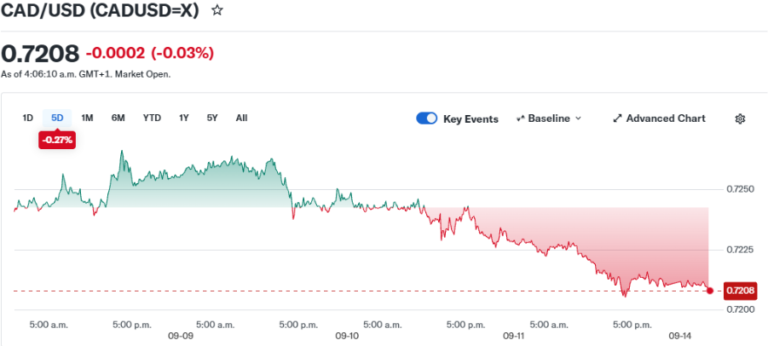
Canadian Dollar vs. U.S. Dollar (CADUSD=X)
The Canadian dollar strengthened briefly early in the week, reaching a high of US$0.7267 on September 8, before coming under pressure from a stronger U.S. dollar and rising expectations for a U.S. rate hike. Based on Yahoo Finance daily data, CAD/USD closed at 0.7228 on September 11, down approximately 0.33% from 0.7252 on September 4. Overall, the currency moved from an early gain to a weaker, range-bound finish.
Source: Yahoo Finance
Gold & Silver Market:
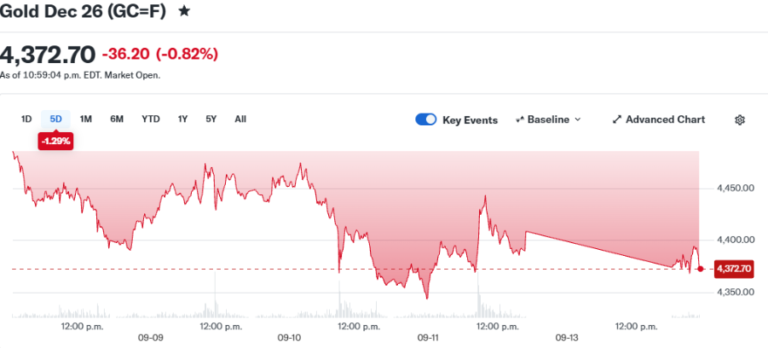
COMEX December 2026 Gold Futures (GC=F)
Gold futures rose early in the week before reversing course. Prices reached a weekly high of US$4,488.80 per ounce on September 8, but later came under pressure as U.S. inflation data strengthened rate-hike expectations and pushed Treasury yields and the U.S. dollar higher. Gold settled at US$4,408.90 on September 11, down approximately 1.51% from September 4. Prices stabilized modestly on Friday, but still recorded a notable weekly decline.
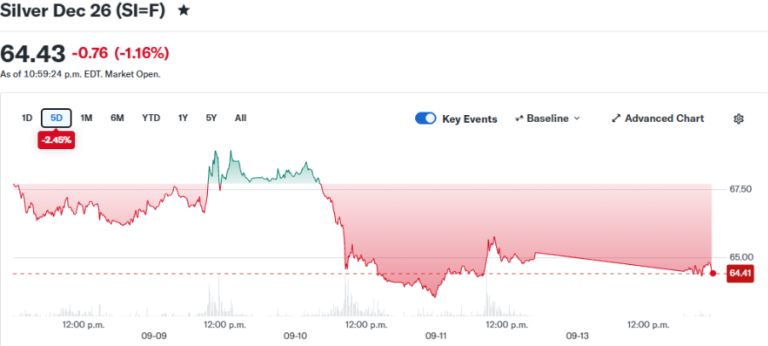
COMEX December 2026 Silver Futures (SI=F)
Silver was considerably more volatile than gold. Prices surged to a weekly high of US$68.980 per ounce on September 9 before reversing sharply. Silver settled at US$65.188 on September 11, down approximately 2.34% from September 4. The sharp rise-and-fall pattern reflected meaningful profit-taking in precious metals as interest-rate expectations shifted.
Source: Yahoo Finance
Oil Market:
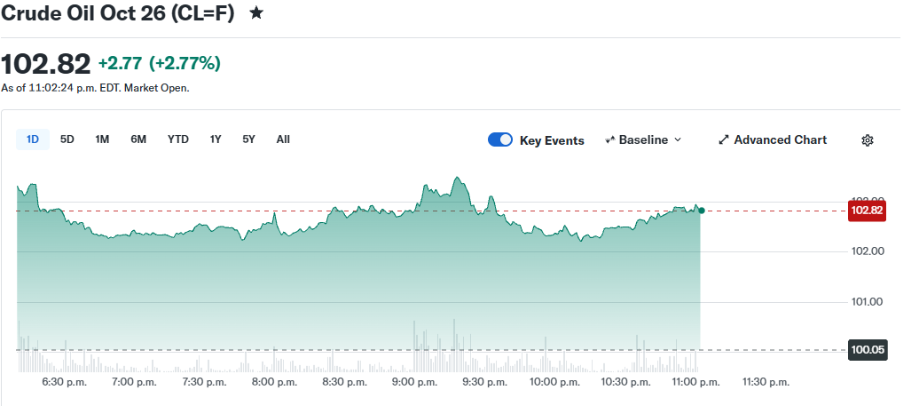
WTI October 2026 Crude Oil Futures (CL=F)
Oil prices rose sharply as concerns over Middle East supply and transportation risks intensified. WTI climbed from US$91.48 per barrel on September 4 and reached an intraday weekly high of US$104.46 on September 11. It settled at US$100.05 that day. Although prices pulled back from the intraday high, WTI still gained approximately 9.37% for the week and remained in a strong upward trend.
- Let us contact you
Investing with an AimStar's investment professional
Want expert advice at every step of your investing journey?
AimStar’s investment professionals can set you on the right course – and they can meet in-person or online.
Financial Market Data Copyright © 2026 AimStar myportfolio. Data as of September 14th, 2026, 15:30 PM EST

WHAT'S HAPPENING THIS WEEK
Upcoming Events This Week
September 14 (Monday)
- Economic Data & Events: Canada August CPI; July manufacturing sales.
September 15 (Tuesday)
- Economic Data & Events: U.S. September Empire State Manufacturing Survey; Canada August existing-home sales; July wholesale sales.
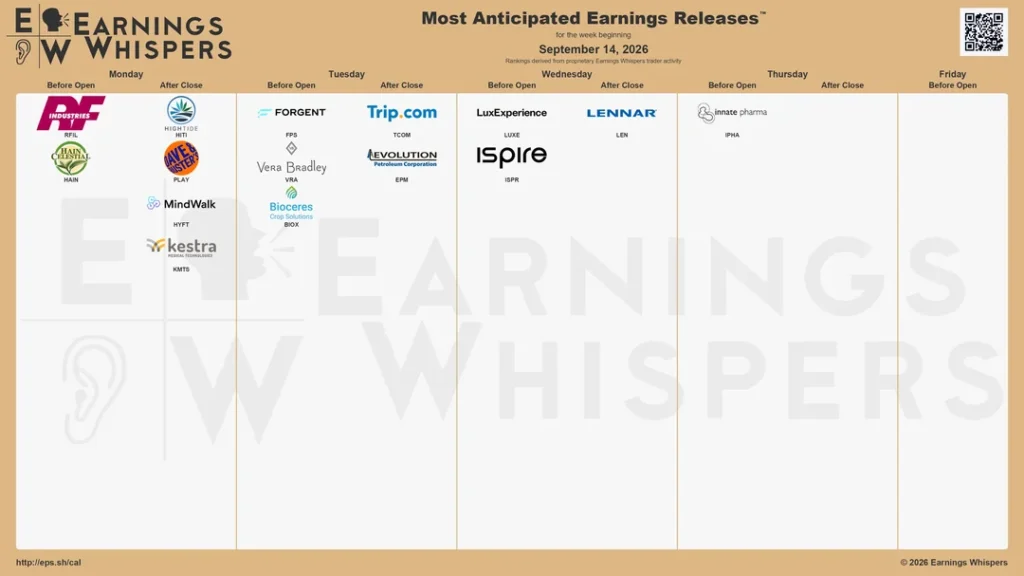
- Key Earnings: Trip.com Group, Vera Bradley, Evolution Petroleum.
September 16 (Wednesday)
- Economic Data & Events: Federal Reserve interest rate decision and updated economic projections; U.S. August retail sales; Bank of Canada meeting summary.
September 17 (Thursday)
- Economic Data & Events: U.S. initial jobless claims; August housing starts and building permits; September Philadelphia Fed Manufacturing Index; Canada August Industrial Product Price Index and Raw Materials Price Index; Bank of England interest rate decision.
- Key Earnings: Innate Pharma.
September 18 (Friday)
- Economic Data & Events: U.S. August industrial production and capacity utilization.
Author by: Sarah San
Edited & Published by: Sarah San
September 14th , 2026 15:30 PM EST. 10 min read

AimStar Capital Group Inc. is a Canadian full-service Investment Dealer, regulated by Canadian Investment Regulatory Organization (CIRO) and a member of Canadian Investor Protection Fund (CIPF). As an independent firm, AimStar is built on a foundation of innovation, integrity, and client-centricity. They are committed to providing unbiased advice and dedicated to the client’s needs, helping them achieve their financial goals.
AimStar is recognized as a Wealth Professionals 5-star Wealth Management Firm for 2024, this award recognized AimStar has offered exceptional client experience, a proven investment track record, continuous innovation, and stringent regulatory compliance.