

Key Focus This Week:
“U.S. and Canadian Employment Data, Economic Activity, and a New Wave of Corporate Earnings to Shape Rate Expectations”
This week, market attention will shift from last week’s central bank decisions and mega-cap technology earnings to labor market conditions in the United States and Canada, corporate hiring trends, services sector activity, and a new round of earnings across multiple industries.
With the Federal Reserve leaving interest rates unchanged last week while providing limited forward guidance, upcoming employment and economic activity data are expected to play a more direct role in shaping market expectations for future monetary policy. Meanwhile, geopolitical developments in the Middle East and continued volatility in crude oil prices remain important factors influencing inflation expectations, bond yields, and overall market sentiment.
The United States will release Job Openings, labor productivity figures, and the monthly employment report this week. Investors will closely monitor whether hiring demand continues to moderate, whether workers’ willingness to voluntarily leave their jobs changes, and whether employment growth remains broadly balanced with labor supply.
If job openings and hiring activity remain resilient, markets may conclude that the U.S. economy continues to expand at a healthy pace. However, stronger labor market conditions could also reinforce concerns that wage growth and services inflation may remain elevated, potentially encouraging the Federal Reserve to maintain a cautious policy stance. Conversely, a noticeable slowdown in labor demand could ease concerns about further policy tightening while increasing worries about a broader economic slowdown.
With the Federal Reserve providing less explicit forward guidance, market volatility surrounding this week’s employment releases could increase significantly. Investors will focus not only on payroll growth but also on the unemployment rate, labor force participation, and wage growth for a more comprehensive assessment of labor market conditions.
Recent survey data indicate that U.S. manufacturing activity continues to improve, supported by stronger order growth, improving factory employment, and sustained investment in AI infrastructure and industrial equipment.
However, businesses continue to report elevated transportation, energy, semiconductor component, and raw material costs, while geopolitical tensions in the Middle East continue to disrupt portions of global supply chains. As a result, manufacturing expansion remains accompanied by persistent inflationary pressures rather than representing purely non-inflationary growth.
This week’s ISM Services Index and labor productivity report will provide additional insight into whether economic momentum is broadening beyond technology and manufacturing. Productivity growth remains particularly important, as continued improvements could help offset rising labor costs and reduce inflationary pressure over time.
Canada will release its latest Labour Force Survey this week. Recent economic data have pointed to improving activity, although performance remains uneven across sectors. Investors will therefore watch closely to determine whether employment gains are broadening beyond energy, real estate, and selected service industries into manufacturing and other trade-sensitive sectors.
A continued stabilization in employment could reinforce expectations that Canada’s economic recovery is becoming more sustainable while reducing the urgency for the Bank of Canada to adjust monetary policy in the near term. Conversely, renewed weakness in hiring or rising unemployment could prompt markets to reassess the outlook for household consumption and domestic demand.
Canada’s trade report released earlier this week suggested improving trade conditions on the surface. However, exchange rate movements had a significant impact on reported import and export values. When measured in other currencies, trade activity appeared considerably less robust, suggesting that stronger external demand should not be inferred solely from the headline trade balance.
Following last week’s peak in mega-cap technology earnings, investor attention will shift toward semiconductors, media and entertainment, pharmaceuticals, industrials, and software companies.
AMD’s earnings will offer valuable insight into demand for AI accelerators, data center processors, and the personal computer market. After last week’s mixed reactions to major technology earnings, investors will continue evaluating whether AI investments are translating into sustainable revenue growth, stronger profitability, and improved cash flow rather than simply higher capital expenditures.
Disney’s earnings will provide an update on trends across streaming services, advertising, film production, and theme parks. Investors are likely to focus more on streaming profitability and discretionary consumer spending than subscriber growth alone.
Eli Lilly’s results may influence sentiment across the healthcare sector, with investors closely monitoring demand for key therapies, manufacturing capacity, and future supply plans.
With numerous industrial, software, and pharmaceutical companies also reporting earnings this week, market leadership may continue broadening beyond a small group of mega-cap technology companies.
At the beginning of the week, reports that the United States had delayed additional military action against Iran and resumed diplomatic discussions contributed to a sharp decline in crude oil prices, temporarily easing concerns over energy-driven inflation. Lower oil prices also provided support for both equity and fixed-income markets.
However, conflicting statements from the United States and Iran regarding the status of negotiations, combined with continuing security risks surrounding the Strait of Hormuz, the Red Sea, and regional shipping routes, suggest that oil prices could reverse direction quickly as diplomatic or military developments evolve.
For Canada, lower oil prices could help ease inflationary and interest rate pressures but may also reduce support for energy stocks and the Canadian dollar. Conversely, renewed geopolitical escalation could quickly reverse those market dynamics.
Week’s Key Economic Data & News Recap
Federal Reserve Holds Rates Steady While Maintaining a Cautious Policy Stance
The Federal Reserve kept its policy rate unchanged last week, stating that U.S. economic activity continues to expand at a solid pace while labor market conditions remain generally stable.
At the same time, policymakers emphasized that inflation remains above target and that supply-side risks, particularly those related to energy markets, continue to pose upside risks to inflation. Several policymakers expressed support for further tightening, highlighting continued concern over persistent inflationary pressures.
During the post-meeting press conference, the Fed Chair offered little clarity regarding the timing of future policy moves, leaving markets increasingly dependent on incoming employment and inflation data to assess the likely policy path. This communication approach also suggests that major economic releases could trigger greater volatility across both equity and bond markets.
U.S. Economy Continues to Expand, Although Growth Moderates
The U.S. economy continued to expand during the second quarter, although overall growth slowed compared with earlier periods. Consumer spending, business investment in equipment, and intellectual property investment remained key contributors, while government spending, certain investment categories, and exports softened.
Notably, indicators measuring private domestic demand remained relatively resilient, while household consumption accelerated modestly. These trends suggest that although headline growth has moderated, underlying demand from consumers and businesses remains broadly intact.
Meanwhile, continued investment in AI-related equipment, semiconductors, communications infrastructure, and software underscores the growing importance of technology capital expenditures as a key driver of U.S. economic growth.
Consumer Spending Remains Resilient While Inflation Signals Stay Mixed
Last week’s Personal Income and Personal Spending reports showed continued growth in household consumption, with services spending remaining the primary driver. Inflation-adjusted consumer spending also continued to expand, indicating that households have not yet significantly reduced overall spending.
Inflation data presented a mixed picture. Monthly price pressures moderated somewhat, while core inflation also remained relatively contained. However, longer-term inflation trends continue to run above the Federal Reserve’s target, suggesting that both short-term disinflation and persistent medium-term inflation remain important considerations.
Household income growth continued to slow, while savings remained relatively weak, raising questions about the sustainability of consumer spending going forward.
Labor Costs Continue Rising While Real Wage Growth Remains Under Pressure
U.S. labor costs increased further during the second quarter, with both wages and employee benefit costs continuing to rise. Higher labor costs are expected to remain an important source of inflationary pressure within the services sector and are one reason why the Federal Reserve remains cautious about easing monetary policy.
Meanwhile, after adjusting for inflation, real wage growth for many private-sector workers remained relatively modest. This suggests that rising labor costs are not necessarily translating into stronger household purchasing power and could eventually limit future consumer spending.
Canadian Economic Growth Improves Noticeably
Canada’s monthly GDP report released last week showed continued improvement in overall economic activity. Oil and gas production, construction, manufacturing, financial services, and portions of the retail sector all contributed positively to growth.
The report suggests that Canada’s economy is gradually emerging from its earlier period of weakness, supported by stronger energy production, business investment, and household demand.
However, some of the recent strength may have been influenced by temporary factors such as World Cup-related activity, short-term government hiring, and energy production schedules. Investors will therefore continue monitoring whether the improvement can be sustained over the coming months.
U.S.–Canada Trade Uncertainty Increases Again
Last week, the U.S. President indicated that extending the existing North American trade agreement was not a priority, while trade negotiations between the United States and Canada are expected to continue. Tariffs and market access issues involving steel, aluminum, automobiles, and agricultural products remain unresolved.
These developments have increased uncertainty for Canadian exporters and manufacturers. Despite recent improvements in Canada’s domestic economy, the country’s heavy dependence on U.S. demand means that changes in trade policy could significantly affect business investment, production decisions, and the Canadian dollar.
Mega-Cap Technology Earnings Produce Mixed Results
Last week, major technology companies reported quarterly earnings, and investors clearly differentiated between individual AI-related businesses rather than treating the sector as a single investment theme.
Microsoft and Amazon received positive market reactions as continued strength in cloud computing and AI demand reinforced confidence that AI investments are generating sustainable revenue growth and cash flow.
In contrast, Meta came under pressure because of concerns surrounding cash flow and capital expenditures, while Apple weakened following cautious forward guidance and ongoing supply chain constraints. These reactions suggest investors are increasingly evaluating AI-related companies based on profitability, capital discipline, and return on investment rather than simply rewarding higher AI spending.
Bank of England Holds Rates Steady While Hawkish Voices Increase
The Bank of England left interest rates unchanged last week while continuing to highlight uncertainty surrounding inflation, particularly due to geopolitical tensions and energy prices.
Although underlying inflation has moderated somewhat, several policymakers argued that energy-related shocks could still produce more persistent second-round inflation effects, leading them to support additional rate increases.
The decision reflects a broader challenge facing major central banks globally: economic growth remains moderate, yet inflation risks associated with energy prices, wages, and supply chain disruptions continue to limit the scope for policy easing.
Oil Prices, Bond Yields, and Technology Stocks Experience Heightened Volatility
Last week, crude oil prices remained heavily influenced by geopolitical tensions in the Middle East and shipping disruptions, reinforcing concerns that higher energy prices could sustain inflationary pressures.
U.S. Treasury yields climbed to multi-year highs as investors reassessed inflation persistence and the outlook for future interest rates. Higher bond yields weighed on high-valuation technology stocks and amplified post-earnings volatility across the sector.
Although strong results from Microsoft and Amazon supported a rebound in major equity indices, weakness in Apple, Meta, and parts of the semiconductor sector highlighted continued divergence within the technology industry. Meanwhile, gold failed to fully benefit from geopolitical safe-haven demand as elevated Treasury yields and a stronger U.S. dollar limited upside.
Investing with an AimStar's investment professional
Want expert advice at every step of your investing journey?
AimStar’s investment professionals can set you on the right course – and they can meet in-person or online.

Market Performance Review – Last Week
Source: Yahoo Finance
Canadian Equities:
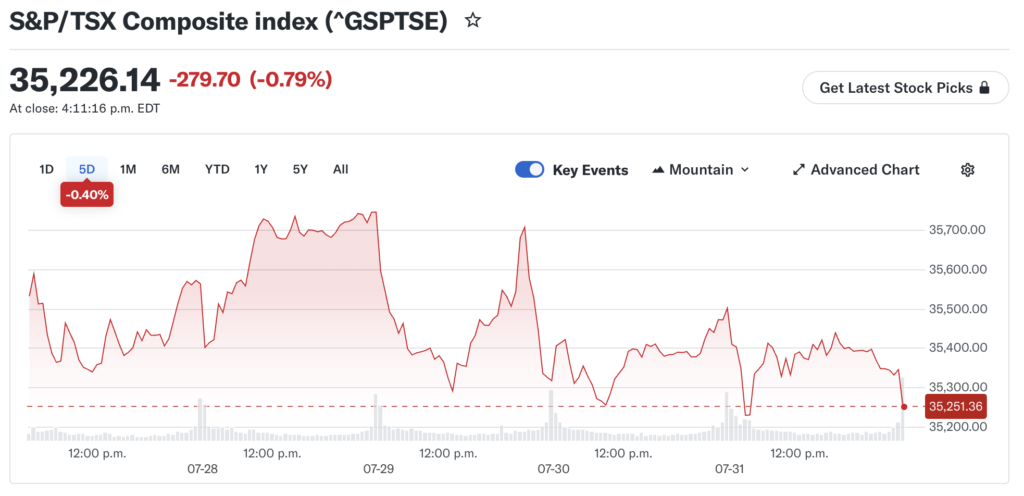
Last week, the S&P/TSX Composite Index traded largely within a 35,200.00–35,700.00 range, trending lower over the course of the week. The index declined 0.40% over the five trading days to close at 35,226.10. It briefly climbed to around the 35,700 level during the week before retreating as profit-taking and softer risk sentiment weighed on the market, ultimately falling to its weekly low on Friday.
Source: Yahoo Finance
U.S. Equities:
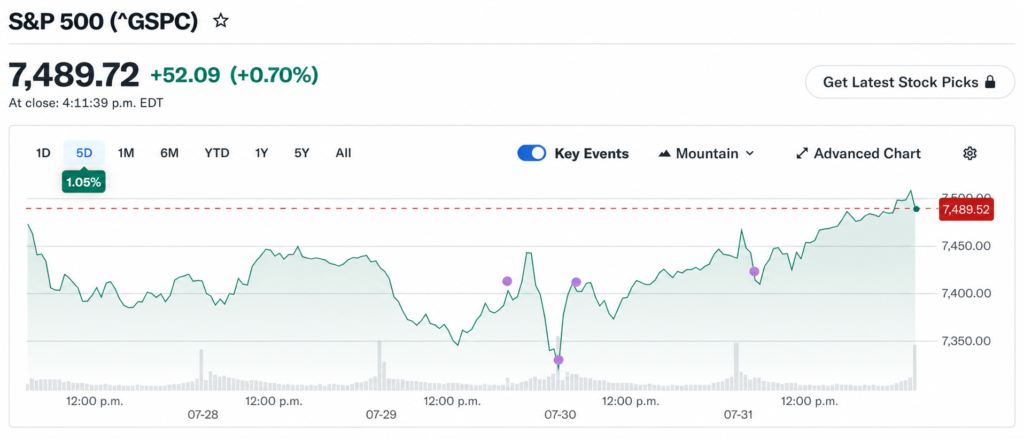
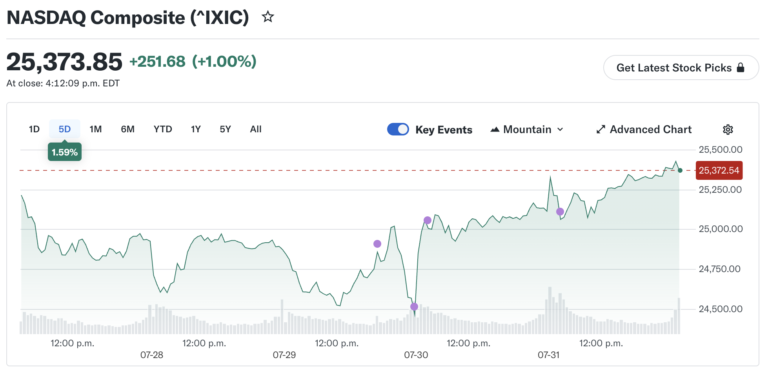
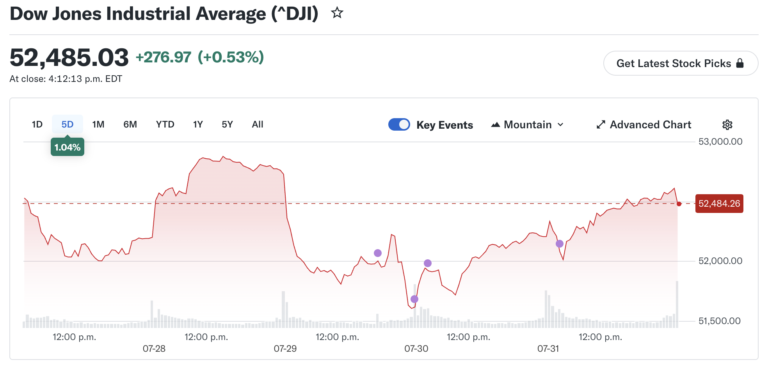
Last week, the three major U.S. stock indices showed an overall recovery trend, with markets moving higher amid support from the Federal Reserve’s decision to keep interest rates unchanged, resilient U.S. economic data, and strong earnings performances from major technology companies. The S&P 500 Index traded within the range of 7,350.00 – 7,500.00, moving gradually higher throughout the week. The index gained 1.05% over the past five trading days, closing at 7,489.52. The NASDAQ Composite fluctuated between 24,500.00 – 25,400.00, supported by continued strength in large-cap technology stocks. The index advanced 1.59% over five trading days, ending the week at 25,373.85. The Dow Jones Industrial Average traded within an approximate range of 52,000 – 53,300, also trending upward and recording a gain over the five-day period.
Source: Yahoo Finance
U.S. Bonds:
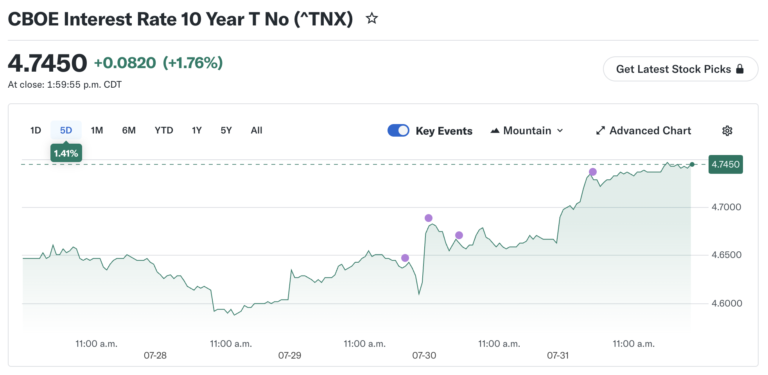
Last week, the U.S. 10-Year Treasury yield (CBOE Interest Rate 10 Year T Note, ^TNX) continued its upward trend amid ongoing market adjustments. The yield fluctuated within the range of 4.59%–4.75% and increased by approximately 1.8% over the past five trading days, closing at 4.745%.
Source: Yahoo Finance
Forex Market:
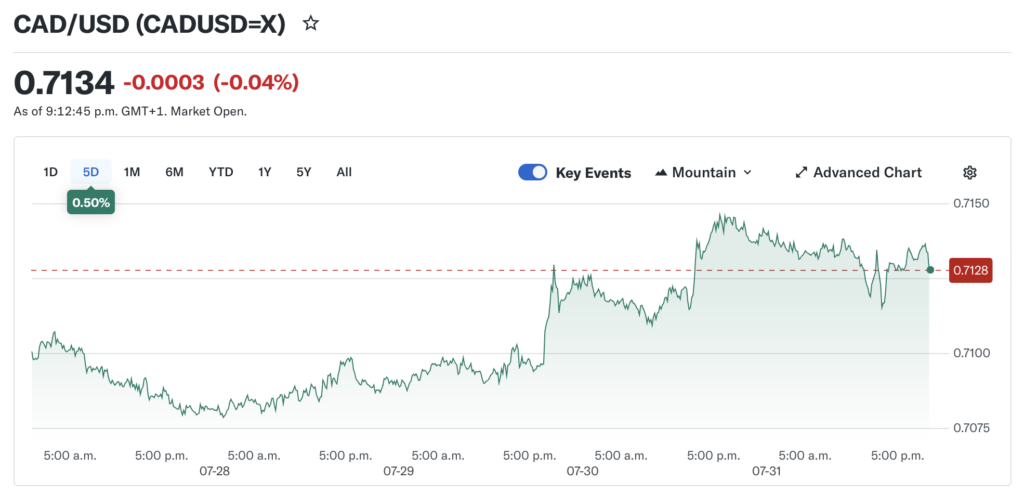
Last week, the Canadian dollar (CAD/USD) strengthened overall, continuing its upward momentum against the U.S. dollar. The exchange rate rose from around 0.7090 to 0.7134, recording a five-day gain of approximately 0.5% and closing at 0.7134. During the week, the currency pair briefly reached around 0.7150, marking a recent high. The Canadian dollar’s relative resilience was supported by stable Canadian economic data, improving market risk sentiment, and a more differentiated performance of the U.S. dollar against other major currencies.
Source: Yahoo Finance
Gold & Silver Market:
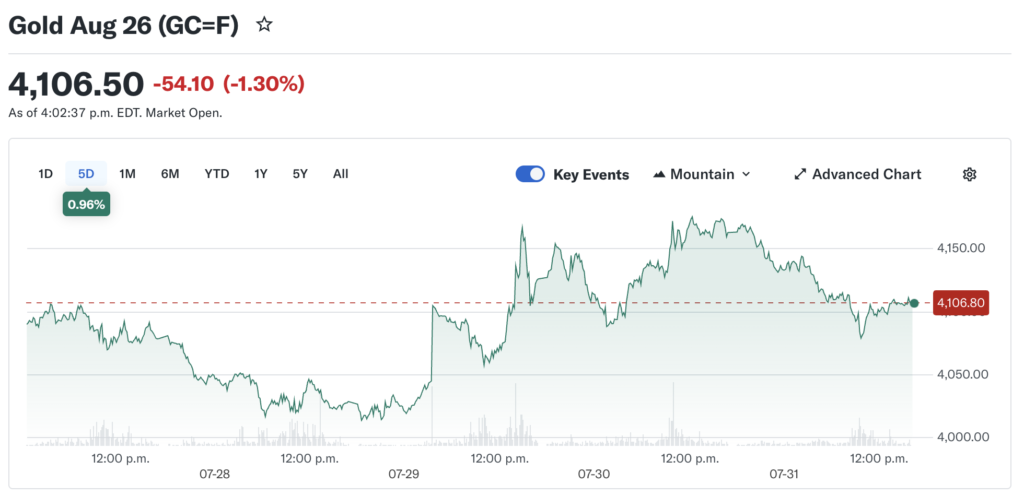
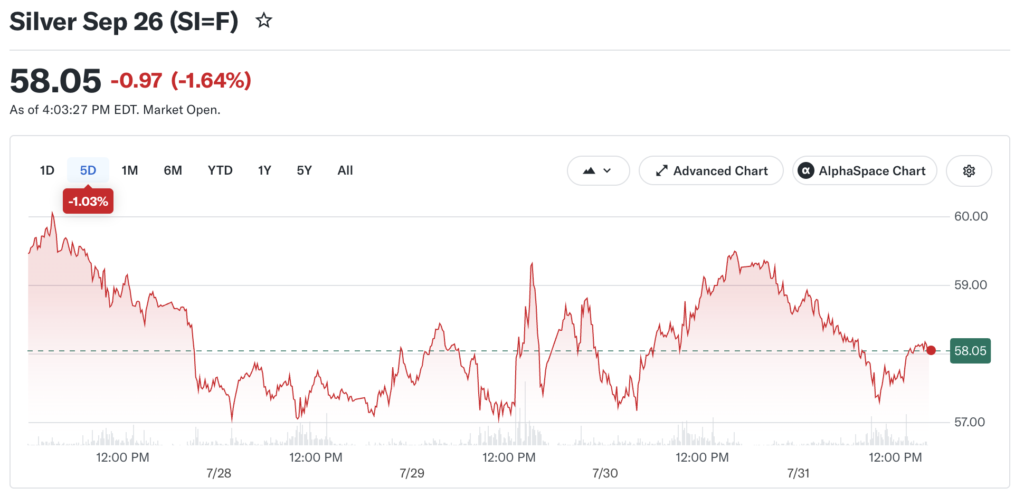
Last week, the precious metals market faced overall pressure, with both gold and silver futures declining during the week. COMEX Gold Futures (GC=F) recorded a five-day decline of approximately 1.0%, closing at $4,106.50 per ounce. COMEX Silver Futures (SI=F) also fell by around 1.0% over five trading days, ending the week at $58.05 per ounce. During the week, gold briefly reached around $4,160 per ounce, while silver climbed to approximately $59.50 per ounce before retreating as the market experienced profit-taking and continued adjustments in precious metal positions.
Source: Yahoo Finance
Oil Market:
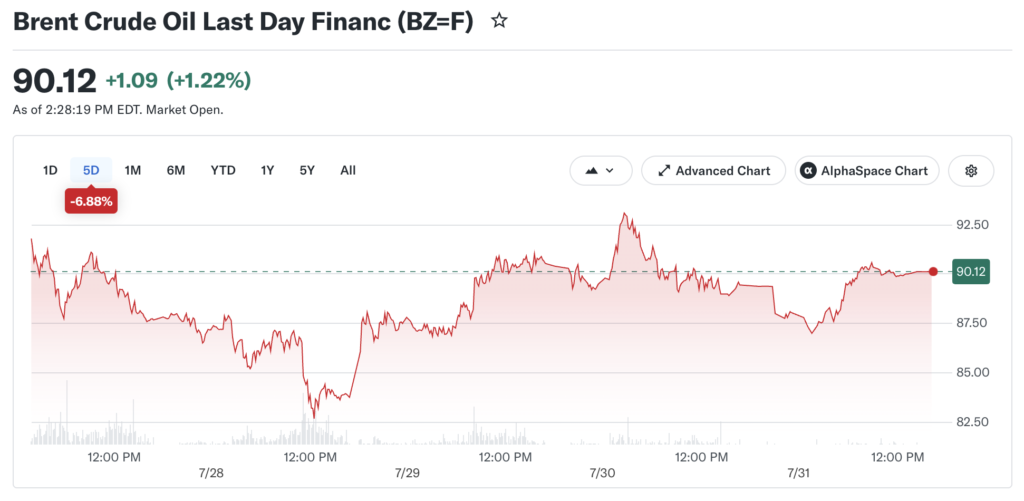
Last week, Brent crude oil futures traded in a downward trend, fluctuating within the range of approximately US$83.00 – US$90.50. Although prices rebounded on Friday, the commodity still recorded an overall weekly decline, closing at US$90.12 per barrel.
- Let us contact you
Investing with an AimStar's investment professional
Want expert advice at every step of your investing journey?
AimStar’s investment professionals can set you on the right course – and they can meet in-person or online.
Financial Market Data Copyright © 2026 AimStar myportfolio. Data as of August 4th, 2026, 12:30 PM EST

WHAT'S HAPPENING THIS WEEK

Upcoming Events (August 3 – August 7, 2026)
August 3 (Monday)
Before Market Open:
Easterly Government Properties, Marriott International, SPAR Group, TG Therapeutics, Krystal Biotech, Avista, American Bitcoin, Alexander Inc., Compugen, and CNH Industrial are scheduled to release earnings reports.
After Market Close:
Palantir, Sterling Infrastructure, The Clorox Company, Baxter International, Whirlpool, Jazz Pharmaceuticals, Vertex Pharmaceuticals, Snap, ON Semiconductor, and TKO Group are scheduled to report earnings.
August 4 (Tuesday)
Before Market Open:
Pfizer, Caterpillar, McDonald’s, Wayfair, Hut 8, Wix.com, Shoals Technologies, Enlight Renewable Energy, Merck, and Hecla Mining are scheduled to release earnings reports.
After Market Close:
AMD, SpaceX, Arista Networks, Astera Labs, Zeta Global, Opendoor, Booking Holdings, Kratos Defense, and Allegiant Travel are scheduled to report earnings.
August 5 (Wednesday)
Before Market Open:
Eli Lilly, Shopify, Uber, The Walt Disney Company, 1stdibs, Riot Platforms, Circle Internet Group, Bloomin’ Brands, Unity Software, and Novo Nordisk are scheduled to release earnings reports.
After Market Close:
SanDisk, Western Digital, AppLovin, e.l.f. Beauty, Timken, MercadoLibre, Redwire, Axon Enterprise, Beyond Meat, and Albemarle are scheduled to report earnings.
August 6 (Thursday)
Before Market Open:
ConocoPhillips, D-Wave Quantum, Datadog, Celsius Holdings, CF Industries, Himax Technologies, C3.ai (AI NOW), Fiserv, Viatris, and Cheniere Energy are scheduled to release earnings reports.
After Market Close:
DraftKings, Airbnb, AOI (Applied Optoelectronics), Century Aluminum, 10x Genomics, Rigetti Computing, The Trade Desk, Innodata, Red Cat Holdings, and MP Materials are scheduled to report earnings.
August 7 (Friday)
Before Market Open:
Oklo, Vistra Energy, T2 Biosystems, PPL Corporation, Wendy’s, Under Armour, AdvanSix, ACM Research, V2X, and Canopy Growth are scheduled to release earnings reports.
Author by: Sarah San
Edited & Published by: Sarah San
August 4th , 2026 13:00 PM EST. 10 min read

AimStar Capital Group Inc. is a Canadian full-service Investment Dealer, regulated by Canadian Investment Regulatory Organization (CIRO) and a member of Canadian Investor Protection Fund (CIPF). As an independent firm, AimStar is built on a foundation of innovation, integrity, and client-centricity. They are committed to providing unbiased advice and dedicated to the client’s needs, helping them achieve their financial goals.
AimStar is recognized as a Wealth Professionals 5-star Wealth Management Firm for 2024, this award recognized AimStar has offered exceptional client experience, a proven investment track record, continuous innovation, and stringent regulatory compliance.