

Key Focus This Week: “Growth Concerns and Policy Uncertainty Keep Markets Cautious”
During the past week, North American equity markets were primarily driven by three key macro factors, with heightened volatility reflecting growing uncertainty around inflation, monetary policy, and geopolitical risks.
First, escalating geopolitical tensions in the Middle East became the dominant catalyst for global markets. Concerns surrounding potential disruptions to oil supply, particularly involving Iran, pushed crude prices sharply higher, with Brent crude approaching the mid-$110s per barrel at peak levels during the week. Although there were brief pullbacks following headlines suggesting delays in military action, oil prices remained elevated overall. This surge in energy prices has increased the risk that inflation may reaccelerate, potentially complicating the outlook for monetary policy in the coming months. Investor sentiment may turn more defensive, and broader equity markets experienced pressure due to rising input costs and macro uncertainty.
Second, uncertainty around the U.S. Federal Reserve’s policy path intensified. Recent comments from Federal Reserve Chair Jerome Powell reinforced a data-dependent approach, noting that interest rates could move in either direction depending on how inflation and economic growth evolve. While policymakers remain in a wait-and-see mode, markets have interpreted recent developments as reducing the likelihood of near-term rate cuts.
At the same time, elevated energy prices have added complexity to the policy outlook by introducing renewed upside risks to inflation. This combination of policy uncertainty and inflation risk has contributed to fluctuations in Treasury yields and equity valuations, particularly within rate-sensitive growth and technology sectors.
Canadian economic data will come into focus, particularly the release of January GDP by Statistics Canada scheduled for March 31. This data will provide an important update on domestic economic momentum at the start of 2026. Recent indicators have pointed to subdued growth conditions, although the upcoming release will be critical in confirming whether economic momentum has weakened further at the start of 2026.
Recent communication from the Bank of Canada highlights increasing concern over structural economic headwinds, including weaker investment, trade uncertainty, and slower productivity growth. These factors are expected to weigh on the medium-term outlook and influence future policy decisions
Oil Price Surge Drives Inflation Concerns
Energy markets were the dominant driver of global financial conditions during the week, as geopolitical tensions in the Middle East intensified. Concerns over potential supply disruptions pushed Brent crude prices to above $110 per barrel at intraday highs, marking a significant increase compared to prior weeks. According to Reuters, the move was primarily driven by escalating tensions involving Iran and uncertainty around potential military actions. Although prices experienced some pullback following reports of delayed escalation, they remained elevated overall. The sharp rise in oil prices has led to a reassessment of inflation risks, with markets increasingly pricing in the possibility that energy-driven price pressures could delay the disinflation process.
Federal Reserve Maintains a “Wait-and-See” Stance
Monetary policy expectations remained broadly stable during the week, as Jerome Powell reiterated that the economic outlook remains uncertain and that the Federal Reserve is not yet at a point where policy adjustments are required. He emphasized that the current policy stance is “well positioned,” allowing policymakers to remain patient and assess incoming data before making further decisions. This reinforces the view that the Fed is currently in a holding phase, with no immediate urgency to either tighten or ease policy.
He also addressed the impact of tariffs, characterizing related inflationary pressures as likely a one-time price shock, with an estimated impact of approximately 0.5% to 1%. Importantly, he reaffirmed the Federal Reserve’s commitment to bringing inflation sustainably back to its 2% target, signaling that temporary price pressures alone would not be sufficient to alter the broader policy trajectory.
Investing with an AimStar's investment professional
Want expert advice at every step of your investing journey?
AimStar’s investment professionals can set you on the right course – and they can meet in-person or online.

Market Performance Review – Last Week
Source: Yahoo Finance
Canadian Equities:
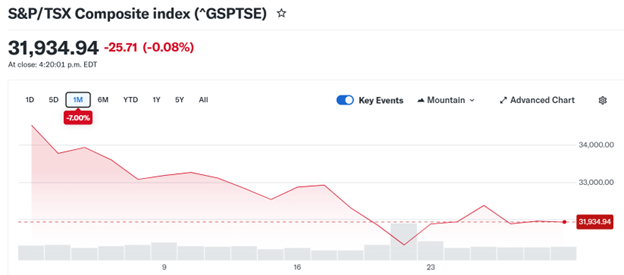
Canadian equities, as measured by the S&P/TSX Composite Index, moved modestly lower over the week, with weakness in financials and materials offsetting strength in energy, as investors remained cautious amid slowing domestic growth and global uncertainty.
Source: Yahoo Finance
U.S. Equities:
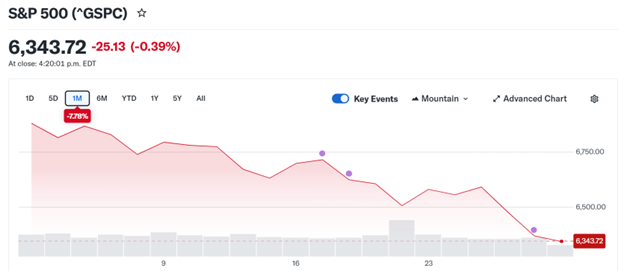
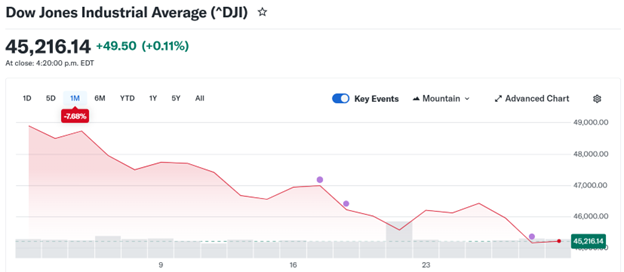
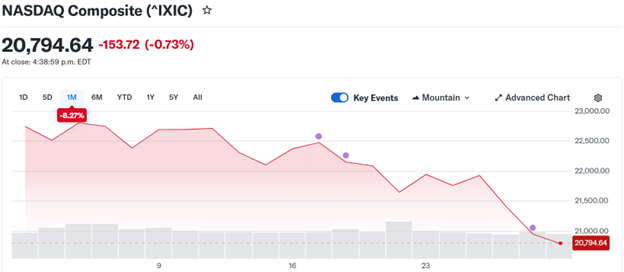
U.S. equity markets moved lower over the week, reflecting continued pressure from elevated interest rates and cautious investor sentiment amid macro uncertainty. The S&P 500 closed at approximately 6368.85, while the Nasdaq Composite declined to around 20948.36. The Dow Jones Industrial Average showed relatively more resilience, ending near 45166.64. The underperformance of the Nasdaq highlights the continued sensitivity of growth and technology stocks to higher yields and policy uncertainty, as investors rotate toward more defensive sectors amid an increasingly complex macro backdrop.
Source: Yahoo Finance
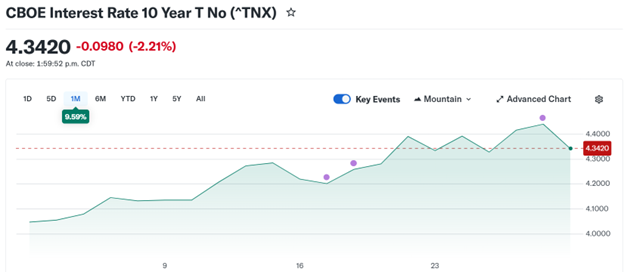
U.S. Bonds:
U.S. Treasury yields moved modestly higher during the week, with the 10-year yield reflecting persistent inflation concerns and a shift in market expectations toward fewer near-term rate cuts.
Source: Yahoo Finance
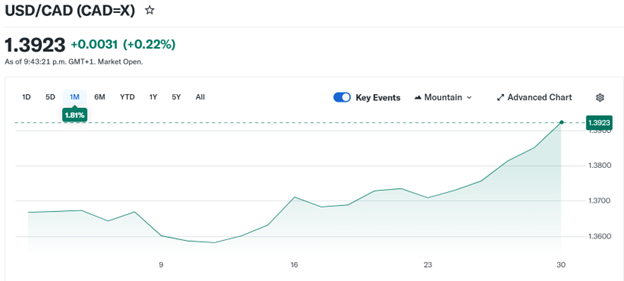
Forex Market:
In the foreign exchange market, the USD/CAD pair trended higher, indicating a weaker Canadian dollar, as softer domestic economic data and external trade uncertainties weighed on sentiment
Source: Yahoo Finance
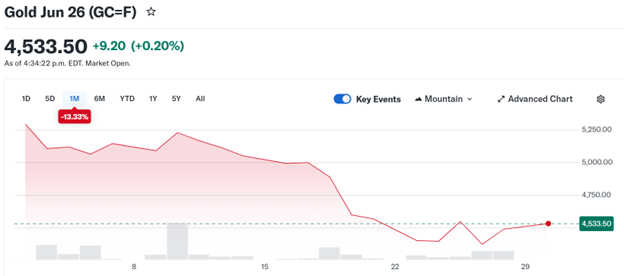
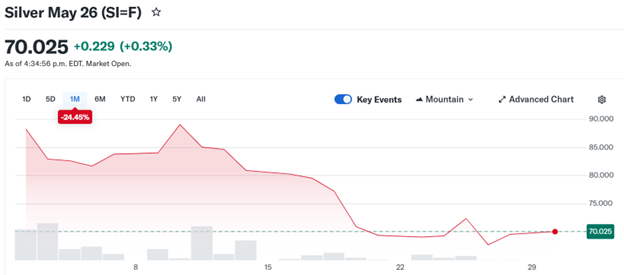
Gold Market& Silver Market:
Gold and silver markets saw continued support, with Gold and Silver benefiting from safe-haven demand and ongoing macro uncertainty, particularly around interest rates and geopolitical risks.
Source: Yahoo Finance
Oil Market:
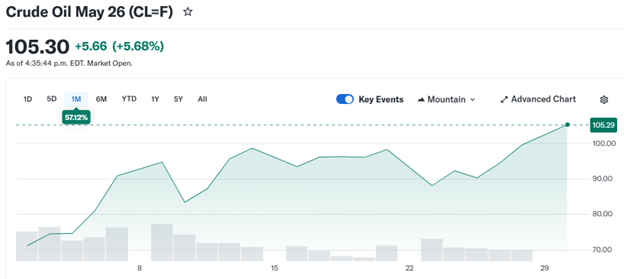
Oil markets remained volatile but elevated, with Crude Oil prices holding near recent highs, supported by supply concerns and geopolitical developments, reinforcing their influence on inflation expectations and broader market sentiment.
- Let us contact you
Investing with an AimStar's investment professional
Want expert advice at every step of your investing journey?
AimStar’s investment professionals can set you on the right course – and they can meet in-person or online.
Financial Market Data Copyright © 2026 AimStar myportfolio. Data as of March 30 , 2026, 12:30 PM EST

WHAT'S HAPPENING THIS WEEK
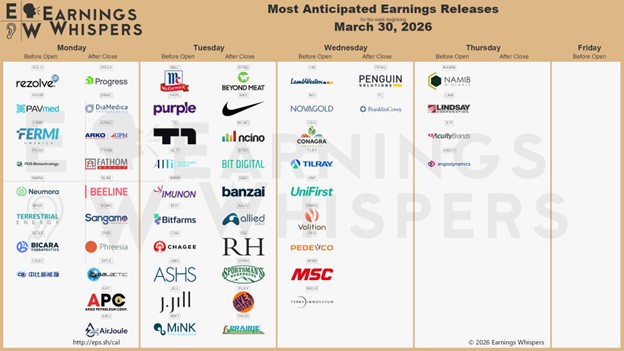
March 30 (Monday)
March 31 (Tuesday)
- Economic Data & Events: Canada’s monthly GDP, the Conference Board’s Consumer Confidence Index
- Key Earnings: Nike. Inc, McCormick & Company,
April 1 (Wednesday)
- Economic Data & Events: U.S. retail sales and manufacturing indicators
- Key Earnings: Lamb Weston, Conagra Brands
April 2 (Thursday)
- Key Earnings: Acuity Brands, Lindsay Corporation
April 3 (Friday)
- Economic Data & Events: Nonfarm payrolls report
Author by: Sarah San
Edited & Published by: Sarah San
March 30 , 2026 13:00 AM EST. 10 min read

AimStar Capital Group Inc. is a Canadian full-service Investment Dealer, regulated by Canadian Investment Regulatory Organization (CIRO) and a member of Canadian Investor Protection Fund (CIPF). As an independent firm, AimStar is built on a foundation of innovation, integrity, and client-centricity. They are committed to providing unbiased advice and dedicated to the client’s needs, helping them achieve their financial goals.
AimStar is recognized as a Wealth Professionals 5-star Wealth Management Firm for 2024, this award recognized AimStar has offered exceptional client experience, a proven investment track record, continuous innovation, and stringent regulatory compliance.