

Key Focus This Week:
This Week’s Focus: This Week’s Focus: Fed Rate Outlook, Treasury Yields and Energy Markets
Global financial markets experienced heightened volatility this week, driven by rising Treasury yields, elevated energy prices, persistent inflation concerns, and a series of U.S. economic data releases. The U.S. 10-year Treasury yield briefly climbed to approximately 5.34%, reaching its highest level since 2002, while the 30-year Treasury yield also rose to multi-year highs. Expectations for further monetary tightening by the Federal Reserve temporarily increased, triggering a sell-off in the bond market and putting pressure on equity valuations. At the same time, ongoing developments in the Middle East continued to influence oil supply expectations, with Brent crude briefly trading above $100 per barrel, adding to concerns over energy costs and inflation.
On the economic front, August PCE inflation came in below market expectations, while the third estimate of second-quarter GDP was revised up to an annualized growth rate of 2.2%, indicating continued support from consumer spending and investment. The September ADP report showed a gain of 90,000 private-sector jobs. However, Friday’s official nonfarm payrolls report pointed to a notable slowdown in labor-market growth, with payrolls increasing by only 29,000 and the unemployment rate rising to 4.2%. Following the employment report, expectations for another Federal Reserve rate hike this year eased significantly, prompting a rebound in major U.S. equity indexes and a retreat in Treasury yields from their highs. Overall, markets continued to balance a high-rate environment, elevated energy prices, and resilient economic growth, keeping the Federal Reserve’s future policy path firmly in focus.
Last Week’s Key Economic Data & News Recap
U.S. Treasury Yields Rise to Multi-Year Highs, Weighing on Global Bond Markets
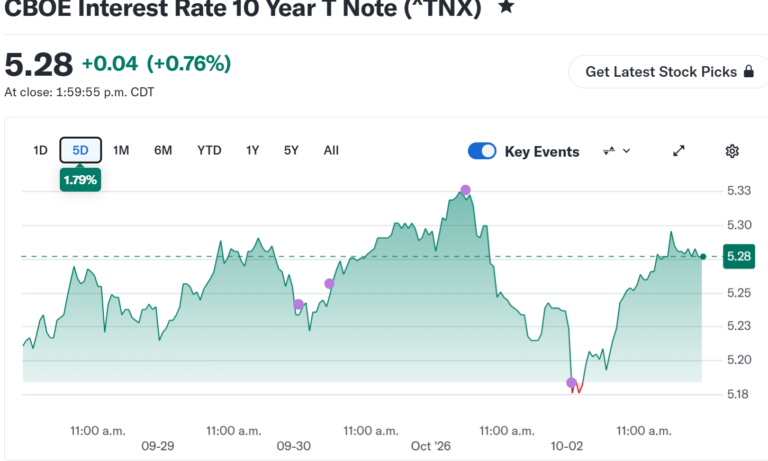
Global bond markets remained under pressure this week, with long-term U.S. Treasury yields reaching their highest levels in years. The 10-year Treasury yield briefly surpassed 5.3%, reaching one of its highest levels since before the 2007–2008 financial crisis. The rise in yields was driven by several factors, including inflation concerns stemming from higher energy prices, expectations for further Federal Reserve tightening, and the significant capital requirements associated with artificial intelligence and data-center investment. As borrowing costs increased, investors began reassessing the funding costs faced by high-valuation technology companies and debt-dependent sectors. On October 2, weaker-than-expected employment data triggered a rebound in the bond market, pushing the 10-year Treasury yield back toward the 5.2% level.
U.S. Labor Market Shows Clear Signs of Moderation, Easing Rate-Hike Expectations
The U.S. labor market was another key focus for investors this week. The ADP employment report released on September 30 showed that private-sector employment increased by 90,000 in September, while the third estimate of second-quarter GDP was revised up to an annualized growth rate of 2.2%. However, the September nonfarm payrolls report released on October 2 presented a notably weaker picture. Nonfarm payrolls increased by only 29,000, below market expectations of approximately 84,000–90,000, while the unemployment rate rose from 4.1% in August to 4.2%. Employment growth for the previous two months was also revised down by a combined 60,000 jobs. Average hourly earnings increased 0.1% month over month and 3.0% year over year. The slowdown in employment growth led markets to reassess the need for further near-term Federal Reserve tightening, resulting in a significant decline in expectations for another rate hike this year.
PCE Inflation Comes in Below Expectations, While Consumer Spending Remains Resilient
On September 30, the U.S. released its August Personal Income and Outlays report. August PCE inflation came in below market expectations, while consumer spending continued to grow, indicating continued resilience in household consumption. As one of the Federal Reserve’s preferred inflation measures, the relatively moderate PCE reading provided some relief to markets, although higher energy prices and potential supply-chain cost pressures could continue to affect the inflation outlook. The same day, the third estimate of U.S. second-quarter GDP showed annualized growth of 2.2%, revised higher from the previous estimate, supported primarily by investment, consumer spending, and government spending. The combination of continued economic growth and a moderating labor market has made the outlook for future Federal Reserve policy increasingly complex.
Middle East Developments and Oil Price Volatility Continue to Influence Inflation Expectations
Developments in the Middle East continued to influence global energy markets this week. On September 28, uncertainty surrounding developments in the region and the outlook for negotiations prompted markets to reassess risks to oil supplies, leading to significant volatility in both WTI and Brent crude prices. WTI crude traded around $90 per barrel for much of the week, while Brent briefly moved above $100 per barrel. Higher energy costs not only increase operating expenses for businesses but also reinforce concerns over persistent inflation. By October 2, oil prices had pulled back amid reports and discussions surrounding the potential release of strategic petroleum reserves in Europe, as well as the impact of weaker U.S. employment data. However, geopolitical developments and uncertainty surrounding energy supplies remain important long-term market considerations.
AI Investment Boom Meets Rising Financing Costs
Artificial intelligence remained a major theme in global equity markets, but investors increasingly focused on the capital requirements and financing costs associated with expanding AI infrastructure. As major technology companies continue to increase spending on data centers, semiconductors, and related infrastructure, expectations for future AI-driven revenue growth remain elevated. At the same time, higher global bond yields have increased financing costs for technology companies. On September 28, Nvidia announced an additional $150 billion authorization for share repurchases, sending its shares approximately 1.7% higher that day and highlighting continued investor focus on capital returns and cash flows among major technology companies. Meanwhile, the higher-rate environment has encouraged investors to take a closer look at the expected returns, capital efficiency, and payback periods associated with AI-related capital expenditure.
Investing with an AimStar's investment professional
Want expert advice at every step of your investing journey?
AimStar’s investment professionals can set you on the right course – and they can meet in-person or online.

Market Performance Review – Last Week
Source: Yahoo Finance
Canadian Equities:
S&P/TSX Composite
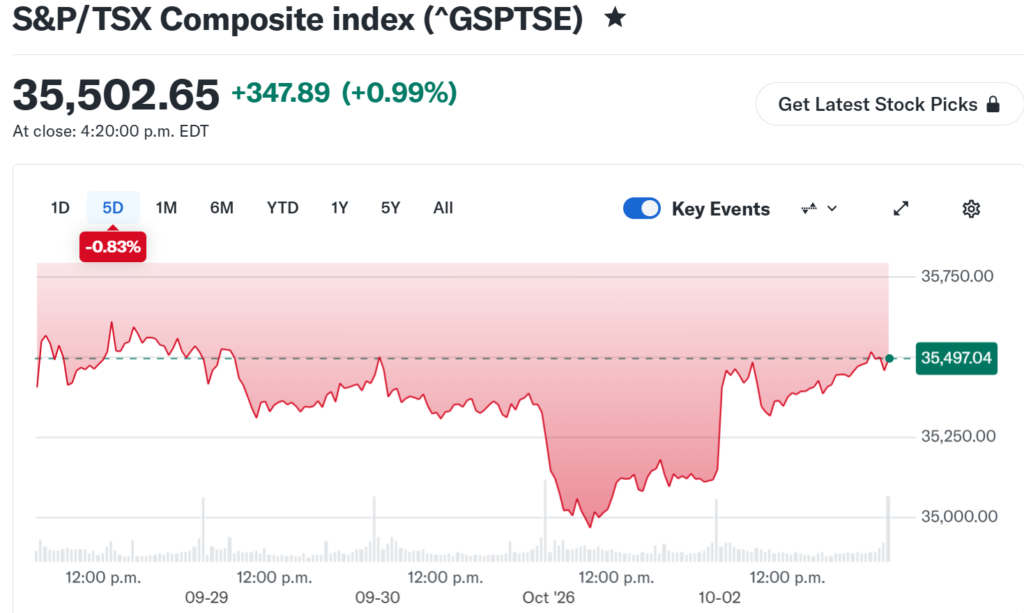
The Canadian equity market finished modestly lower this week, with the S&P/TSX Composite closing at approximately 35,502, down about 0.83% for the week. Although higher oil prices provided some support to the energy sector amid ongoing Middle East tensions, the broader market was weighed down by a sharp rise in global long-term Treasury yields and weakness in the financial sector. Overall, the TSX remained under pressure despite relative strength in energy-related stocks.
Source: Yahoo Finance
U.S. Equities:
S&P 500
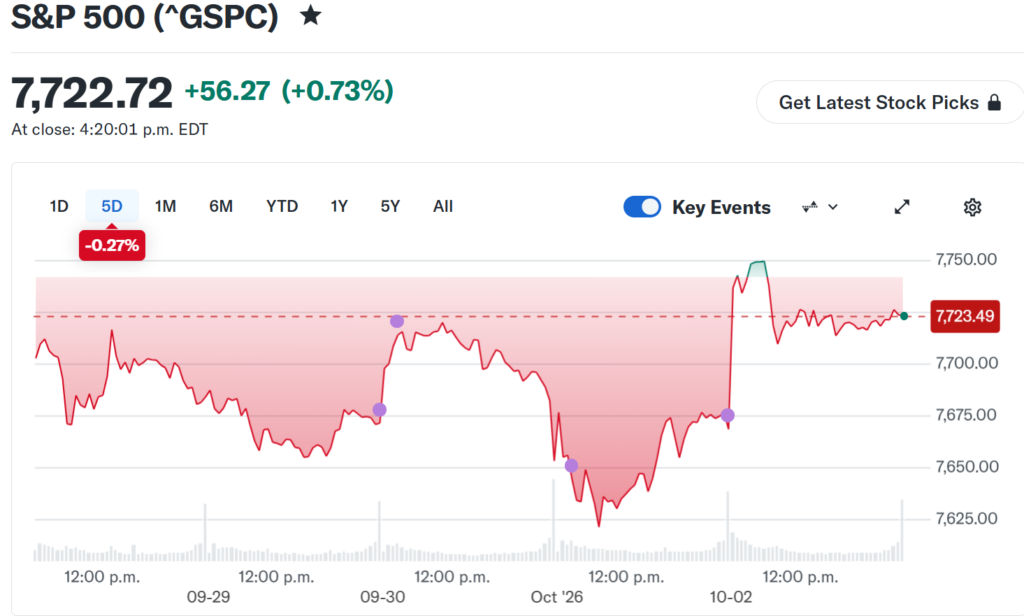
The S&P 500 edged lower by approximately 0.3% for the week, closing at around 7,722. The index came under pressure early in the week as the 10-year Treasury yield moved above 5.3% and oil prices rose sharply. Persistently elevated long-term yields continued to weigh on equity valuations, particularly among higher-valuation assets. However, weaker-than-expected U.S. employment data released on Friday eased concerns over near-term Federal Reserve tightening, supporting a rebound in major equity indexes and bringing the S&P 500 back toward its recent highs.
Dow Jones Industrial Average
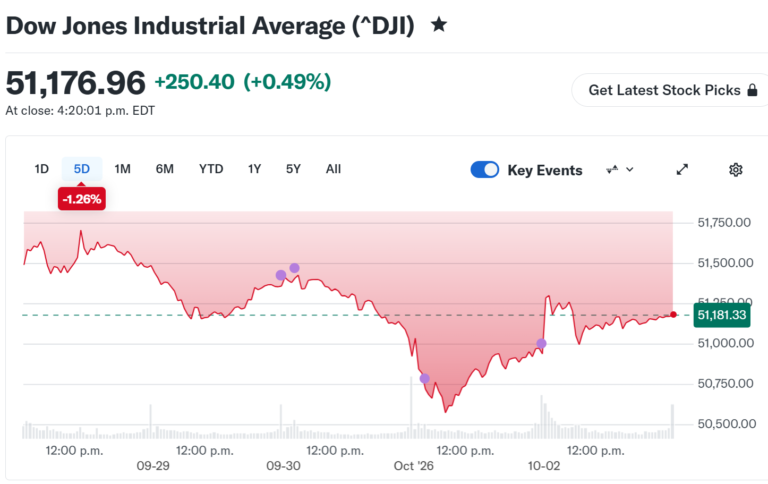
The Dow Jones Industrial Average declined approximately 1.26% for the week, underperforming the broader U.S. equity market. The sharp rise in Treasury yields, together with weakness across traditional industrial and financial sectors, created a headwind for the index. While the Dow recovered some ground following Friday’s employment report, it remained weaker on a weekly basis.
Nasdaq Composite
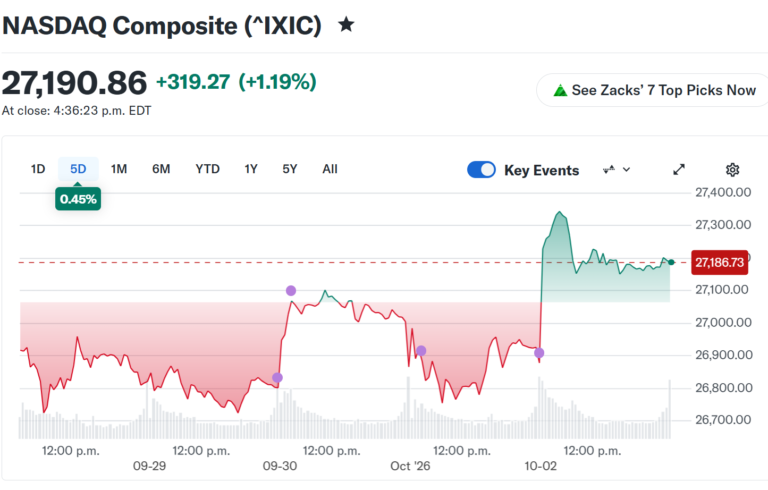
The Nasdaq Composite gained approximately 0.45% for the week, outperforming the other major U.S. equity indexes. Although rising long-term interest rates initially pressured higher-valuation technology stocks, Nvidia’s announcement of an additional $150 billion share-repurchase authorization, together with continued resilience across major technology and semiconductor companies, provided important support. Following Friday’s weaker employment report, concerns over near-term rate hikes eased, prompting a rebound in technology stocks and supporting the Nasdaq.
Source: Yahoo Finance
U.S. Bonds:
The U.S. 10-year Treasury yield rose sharply this week, briefly reaching approximately 5.34%, its highest level since 2002. The sharp rise in long-term yields was one of the most important macro variables affecting global financial markets, tightening financial conditions and placing significant pressure on asset valuations. Following Friday’s weaker employment data, yields retreated from their highs, although they remained elevated by historical standards.
Source: Yahoo Finance
Forex Market:
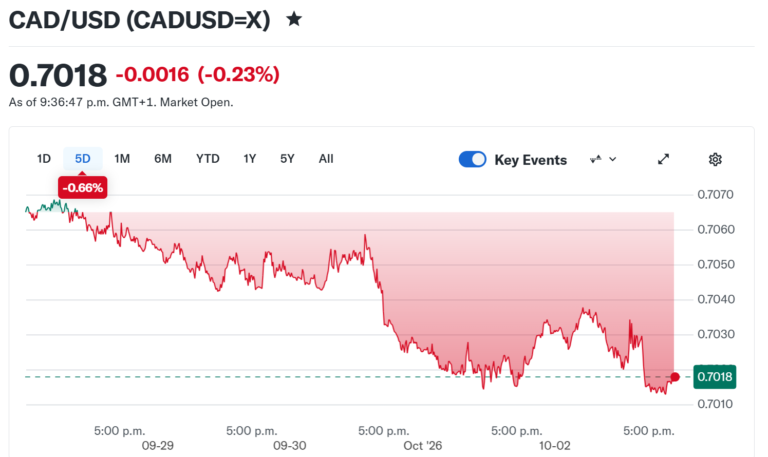
The Canadian dollar weakened modestly against the U.S. dollar this week, with CAD/USD falling toward approximately 0.7280. Although elevated oil prices provided some underlying support for the commodity-sensitive Canadian dollar, widening U.S.-Canada interest-rate differentials and renewed risk aversion continued to weigh on the currency. Overall, the Canadian dollar remained sensitive to both global rate movements and commodity-market conditions.
Source: Yahoo Finance
Gold & Silver Market:
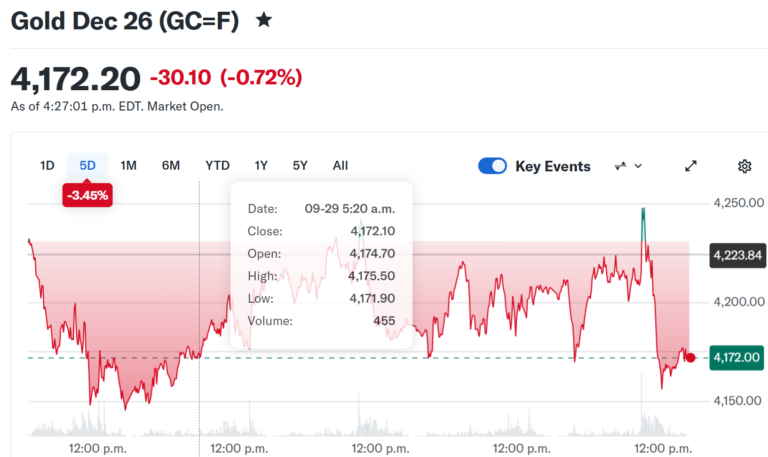
Gold futures declined noticeably this week. Although heightened tensions in the Middle East generated some safe-haven demand, the sharp increase in the U.S. 10-year Treasury yield significantly raised the opportunity cost of holding a non-yielding asset such as gold. As a result, gold remained under pressure and generally moved lower despite intermittent safe-haven buying.
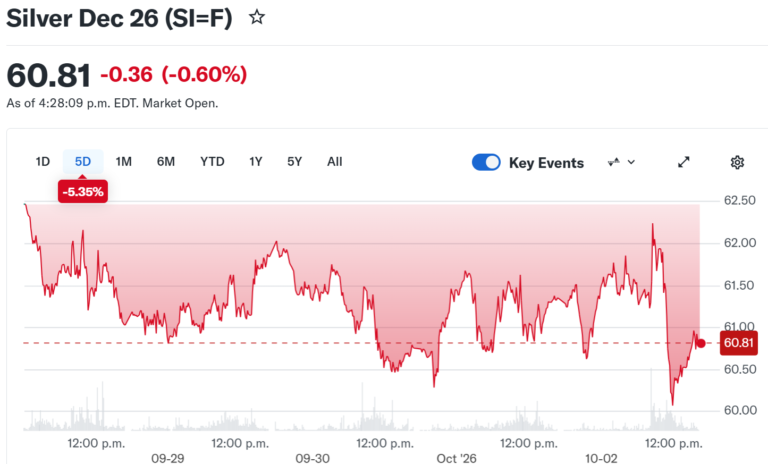
Silver futures declined more sharply than gold during the week. As both a precious metal and an industrial commodity, silver was affected by the surge in Treasury yields as well as concerns over industrial demand and the broader economic outlook. These factors contributed to a larger weekly decline compared with gold.
Source: Yahoo Finance
Oil Market:
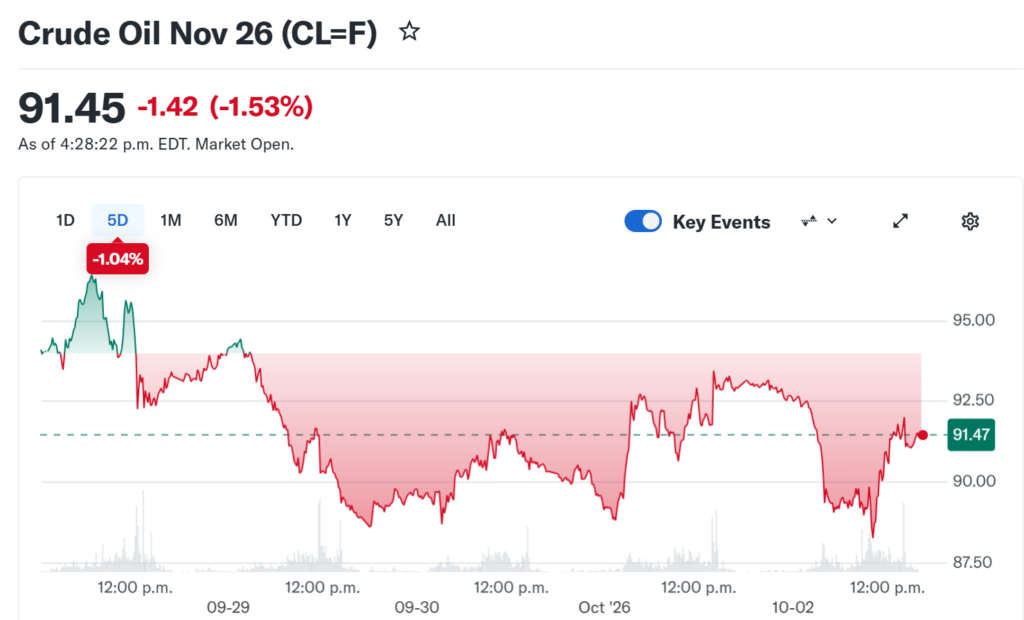
WTI crude oil futures moved through a volatile pattern this week, initially declining, then rebounding before falling again toward the end of the week. WTI settled at approximately $91.40 per barrel on Friday, down about 1.09% from the previous Friday’s close of $92.41. Middle East developments and changing expectations for global oil supplies continued to drive significant price fluctuations throughout the week. At the same time, investors remained focused on the potential impact of higher energy prices on inflation and global demand. Although oil prices recovered temporarily during the week, the decline on Friday left WTI lower on a weekly basis.
- Let us contact you
Investing with an AimStar's investment professional
Want expert advice at every step of your investing journey?
AimStar’s investment professionals can set you on the right course – and they can meet in-person or online.
Financial Market Data Copyright © 2026 AimStar myportfolio. Data as of October 5th, 2026, 15:30 PM EST

WHAT'S HAPPENING THIS WEEK
Upcoming Events This Week
October 5 (Monday)
- Economic Data & Events: U.S. ISM Services PMI (September); S&P Global U.S. Services PMI Final (September).
October 6 (Tuesday)
- Economic Data & Events: U.S. Trade Balance (August); Canada Trade Balance (August).
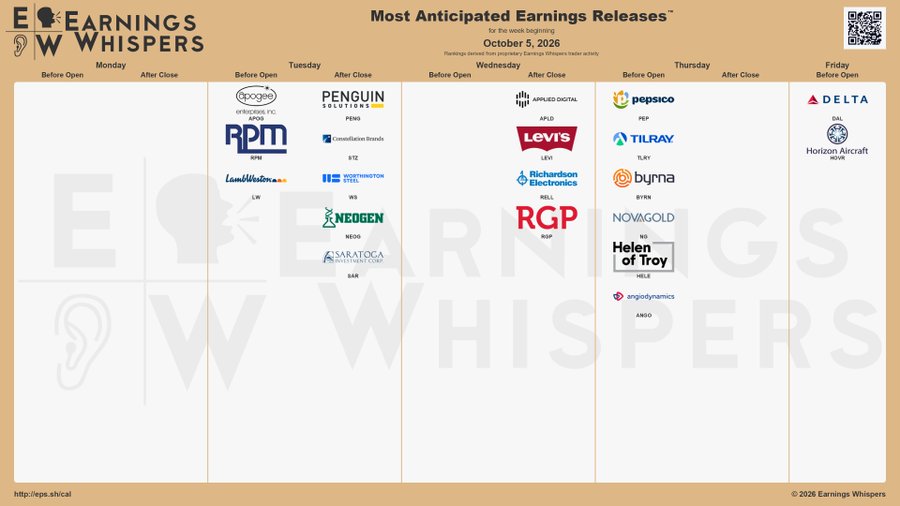
- Key Earnings: Apogee, RPM International, Lamb Weston; after the close, Penguin Solutions, Constellation Brands, Worthington Steel, Neogen, Saratoga Investment.
October 7 (Wednesday)
- Economic Data & Events: Federal Reserve releases the minutes of its September monetary policy meeting; U.S. Consumer Credit (August).
- Key Earnings: Applied Digital; after the close, Levi Strauss, Richardson Electronics, RGP.
October 8 (Thursday)
- Economic Data & Events: U.S. Initial Jobless Claims for the week ending October 3; U.S. Wholesale Inventories (August, final).
- Key Earnings: PepsiCo, Tilray Brands, Byrna Technologies, NovaGold Resources, Helen of Troy, AngioDynamics.
October 9 (Friday)
- Economic Data & Events: Preliminary University of Michigan Consumer Sentiment Index (October).
- Key Earnings: Delta Air Lines, Horizon Aircraft.
Author by: Sarah San
Edited & Published by: Sarah San
October 5th , 2026 15:30 PM EST. 10 min read

AimStar Capital Group Inc. is a Canadian full-service Investment Dealer, regulated by Canadian Investment Regulatory Organization (CIRO) and a member of Canadian Investor Protection Fund (CIPF). As an independent firm, AimStar is built on a foundation of innovation, integrity, and client-centricity. They are committed to providing unbiased advice and dedicated to the client’s needs, helping them achieve their financial goals.
AimStar is recognized as a Wealth Professionals 5-star Wealth Management Firm for 2024, this award recognized AimStar has offered exceptional client experience, a proven investment track record, continuous innovation, and stringent regulatory compliance.