

Key Focus This Week:
This week focus: AI Valuation Reset, Fed Repricing and Broad-Based Market Selloff
Global financial markets came under significant pressure this week, with U.S. and Canadian equities, as well as major commodities, moving lower. Market sentiment was weighed down by concerns over technology stock valuations, a more hawkish shift in Federal Reserve expectations, and growing scrutiny of the potential returns on investment in the artificial intelligence (AI) industry.
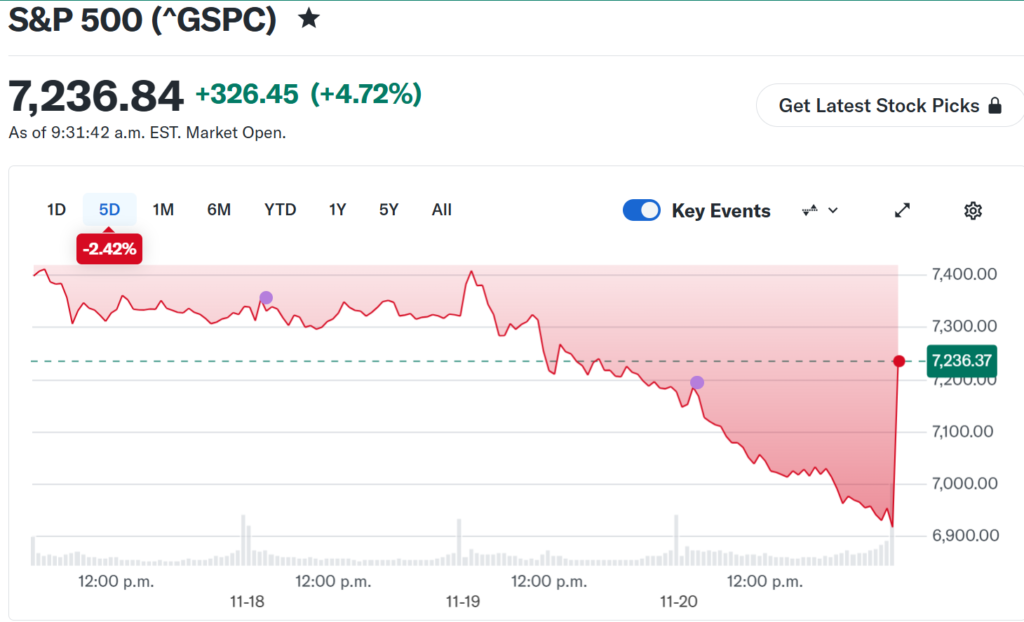
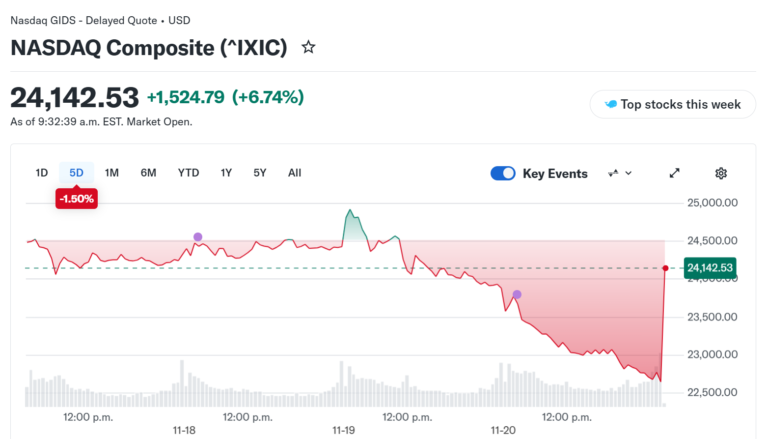
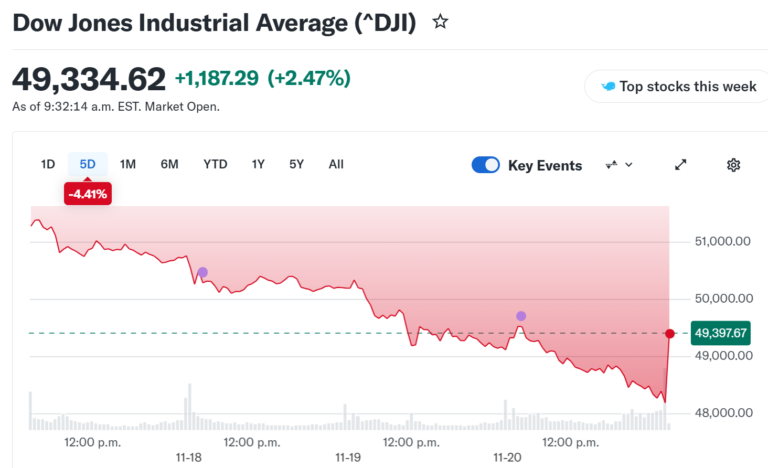
All three major U.S. equity indexes declined for the week, with the Nasdaq Composite underperforming significantly, falling by more than 10%. Both the S&P 500 and the Dow Jones Industrial Average also entered correction territory, defined as a decline of more than 10% from their previous peaks. Technology and semiconductor stocks were the primary sources of selling pressure, as investors increasingly questioned whether substantial AI infrastructure investments could translate into sustainable corporate earnings.
On the monetary policy front, minutes from the Federal Reserve’s October meeting indicated that most officials believed further rate increases could still be necessary to bring inflation under control. This led to a notable increase in market expectations for a potential rate hike in December. However, as investors shifted toward safer assets, U.S. Treasury yields moved lower during the latter part of the week.
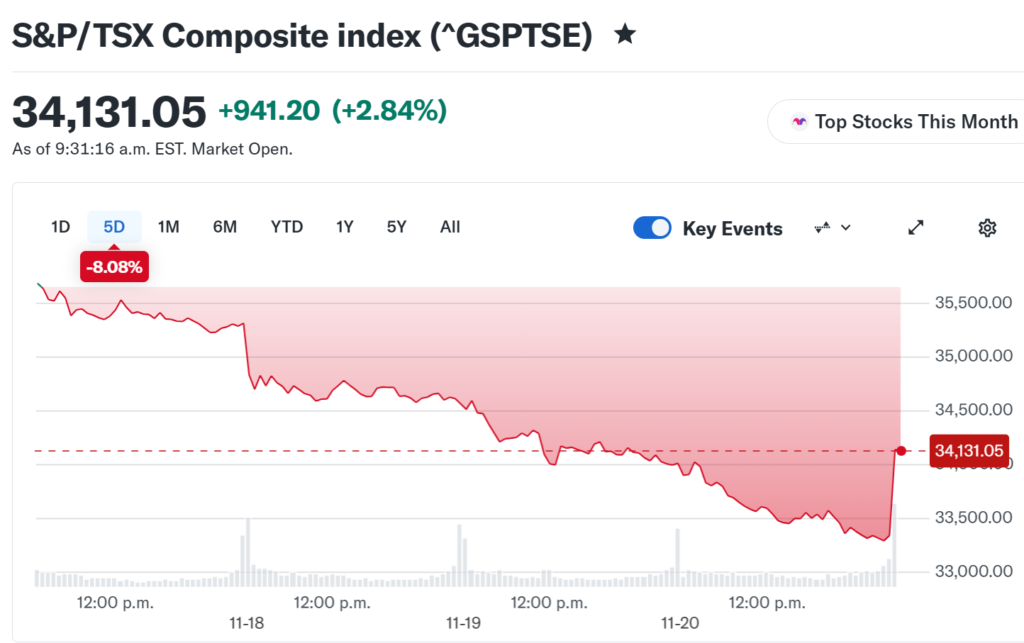
In Canada, retail sales increased by 0.8% in September, while preliminary estimates for October pointed to a potential 1.5% decline, suggesting that consumer spending momentum may be weakening. Meanwhile, the S&P/TSX Composite was also affected by the broader sell-off in risk assets, declining approximately 7.8% for the week.
Overall, the defining theme this week was a significant deterioration in investor risk appetite. Even as several major technology companies reported strong earnings, investors remained focused on valuation levels, capital expenditure returns, and the outlook for interest rates.
Last Week’s Key Economic Data & News Recap
NVIDIA Leadership Changes Draw Market Attention as Jensen Huang’s Departure and Succession Plans Remain in Focus
In addition to reporting strong third-quarter results, NVIDIA’s leadership changes became a major focus for investors this week. On November 12, the company announced that co-founder Jensen Huang would step down as President, Chief Executive Officer and a member of the Board of Directors. Chief Financial Officer Colette Kress was appointed interim CEO. The leadership change followed an internal investigation into matters involving Huang’s personal conduct and related compliance concerns.
On November 17, NVIDIA reported third-quarter revenue of US$115.8 billion, representing year-over-year growth of 103%. Data Center revenue increased by 110% year over year, while the company projected revenue of approximately US$130 billion for the following quarter. However, the strong financial results did not fully alleviate investor concerns surrounding the leadership transition. During the earnings call, Chairman Harvey Jones stated that the Board had no immediate plans to reinstate Huang and had engaged an external firm to assist in the search for a new CEO.
The developments have prompted investors to pay closer attention to NVIDIA’s leadership stability, strategic continuity, and future direction in the AI business. Although the company’s financial performance and revenue guidance remained strong, the leadership uncertainty added another layer of risk to its near-term market performance and investor confidence.
AI Valuation Concerns Intensify, Triggering a Broad Sell-Off in Global Technology Stocks
The primary source of market pressure this week came from the artificial intelligence and technology sectors. Investors began reassessing the substantial capital required to build AI infrastructure and whether future earnings across the industry could meet previously elevated market expectations. As valuation concerns intensified, semiconductor, software, and major technology stocks came under widespread selling pressure.
NVIDIA reported strong third-quarter results, with quarterly revenue reaching US$115.8 billion, up 103% year over year. Data Center revenue totalled US$107.6 billion, representing 110% annual growth. The company also forecast revenue of approximately US$130 billion for the next quarter. Nevertheless, the strong results and outlook were insufficient to ease broader concerns about AI investment returns and industry valuations, leaving the technology sector under significant pressure.
In addition, Anthropic’s post-listing market performance failed to meaningfully restore investor confidence in the AI sector, further intensifying scrutiny of valuations and investment enthusiasm across the industry.
Fed Meeting Minutes Signal a More Hawkish Outlook, Raising December Rate Hike Expectations
The Federal Reserve released the minutes of its October 27–28 policy meeting. The minutes indicated that nearly all participating officials believed further interest rate increases might still be necessary to ensure inflation returns to the central bank’s 2% target. Some officials even suggested that a larger rate increase could be considered at the December meeting.
Policymakers continued to express concerns about persistent inflation, particularly as price pressures across goods and services had not fully subsided. Following the release of the minutes, market expectations for a December rate hike increased, prompting investors to reassess the future path of monetary policy.
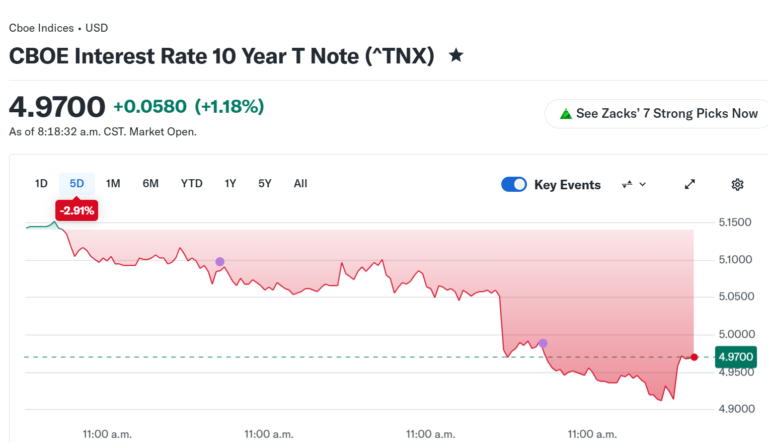
However, as equity markets experienced substantial losses this week, investors increased their exposure to U.S. Treasuries and other safe-haven assets, pushing the 10-year Treasury yield lower toward the end of the week. Markets are now weighing persistent inflationary pressures against the possibility of slowing economic growth.
U.S. Retail Sales Continue to Grow, While Housing Market Indicators Show Mixed Signals
According to data released by the U.S. Census Bureau, retail and food services sales increased by 0.2% month over month in October and were up 6.8% year over year, indicating that consumer spending continued to demonstrate some resilience.
Housing market data presented a mixed picture. Housing starts increased by 9.9% in October to an annualized rate of approximately 1.309 million units. However, building permits declined by 7.4% month over month to approximately 1.295 million units. While the increase in housing starts suggested some improvement in construction activity, the decline in permits pointed to potential weakness in future residential construction.
Meanwhile, the Philadelphia Fed Manufacturing Index fell from 20.9 in October to 6.3 in November, below market expectations. The decline suggested that regional manufacturing activity was expanding at a slower pace. The New Orders Index also moved close to zero, indicating signs of weakening business demand.
Canadian Retail Sales Increase, but Preliminary October Data Point to Slowing Consumer Activity
Statistics Canada reported that retail sales increased by 0.8% month over month in September, reaching C$75.3 billion and slightly exceeding market expectations. Sales at gasoline stations and fuel vendors rose by 6.9%, making a significant contribution to the overall increase.
However, core retail sales increased by only 0.1%, while retail sales volumes, excluding price effects, also rose by just 0.1%. More notably, Statistics Canada’s preliminary estimate for October indicated that retail sales could decline by 1.5% month over month.
These figures suggest that although consumer spending improved in September, Canadian households continue to face elevated living and borrowing costs. Consumer spending growth may therefore remain under pressure in the months ahead.
Investing with an AimStar's investment professional
Want expert advice at every step of your investing journey?
AimStar’s investment professionals can set you on the right course – and they can meet in-person or online.

Market Performance Review – Last Week
Source: Yahoo Finance
Canadian Equities:
The S&P/TSX Composite closed at 33,278.66, declining approximately 7.81% for the week. Deteriorating global risk sentiment placed significant pressure on Canadian equities. Although Canadian retail sales improved in September, the weaker preliminary estimate for October added to concerns about the outlook for domestic economic growth.
Source: Yahoo Finance
U.S. Equities:
S&P 500
The S&P 500 closed at 6,910.39, down approximately 8.61% for the week, officially entering correction territory. Continued weakness in technology and semiconductor stocks was the primary driver of the decline. Despite NVIDIA’s strong earnings performance, concerns surrounding AI valuations and the returns on substantial capital expenditures remained unresolved. Investors increasingly shifted their focus from growth expectations toward earnings quality and more reasonable valuations.
Dow Jones Industrial Average
The Dow Jones Industrial Average closed at 48,147.33, declining approximately 8.02% for the week. Although the Dow has lower technology exposure than the Nasdaq, traditional industrial and large-cap blue-chip stocks also came under pressure as investors broadly reduced their exposure to risk assets. The index’s decline of more than 10% from its previous peak indicated that the market correction had expanded beyond the technology sector.
Nasdaq Composite
The Nasdaq Composite closed at 22,617.73, falling approximately 10.02% for the week and recording the weakest performance among the major U.S. equity indexes. Semiconductor and software stocks faced concentrated selling pressure as concerns over AI-related valuations intensified. As investors reassessed the industry’s earnings potential, high-valuation growth stocks became increasingly vulnerable to volatility.
Source: Yahoo Finance
The U.S. 10-year Treasury yield declined to approximately 4.95%, down around 20 basis points from the previous week’s level of approximately 5.15%. Although the Federal Reserve meeting minutes delivered a hawkish signal, the sharp decline in equity markets encouraged investors to increase their allocations to U.S. Treasuries, pushing yields lower during the latter part of the week.
Source: Yahoo Finance
CAD/USD:
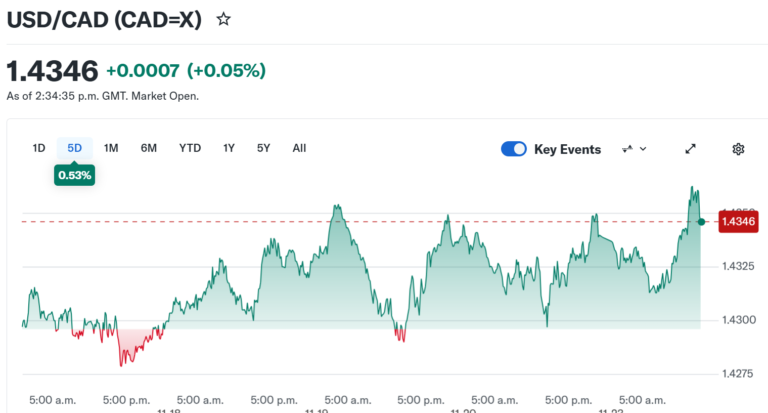
The Canadian dollar weakened further this week. The USD/CAD exchange rate rose to approximately 1.4350, equivalent to around US$0.6969 for every Canadian dollar. A stronger U.S. dollar and increased demand for safe-haven assets placed additional pressure on the loonie. Furthermore, the preliminary estimate of a decline in Canadian retail sales for October added to concerns about domestic consumer activity and economic growth.
Source: Yahoo Finance
Gold & Silver Market:
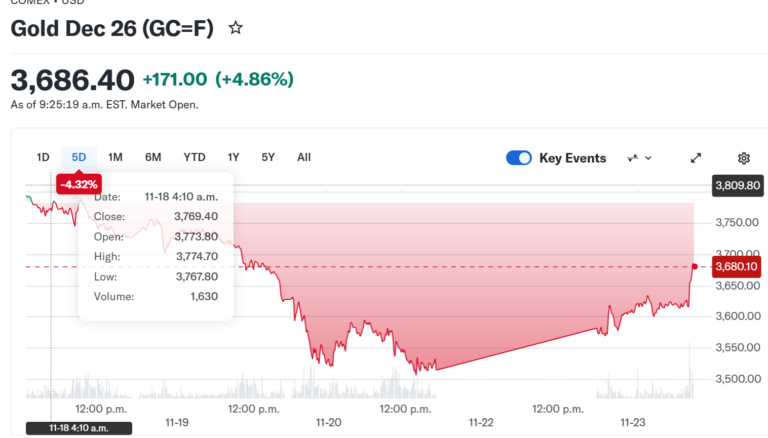
Gold futures closed at approximately US$3,515.40 per ounce, down around 9.5% from the previous week’s close of approximately US$3,886.30. Despite the significant decline in global equity markets, gold failed to demonstrate its traditional safe-haven strength. Instead, prices were pressured by a stronger U.S. dollar and investors’ demand for liquidity. Broader market selling also prompted some investors to liquidate gold positions to raise cash.
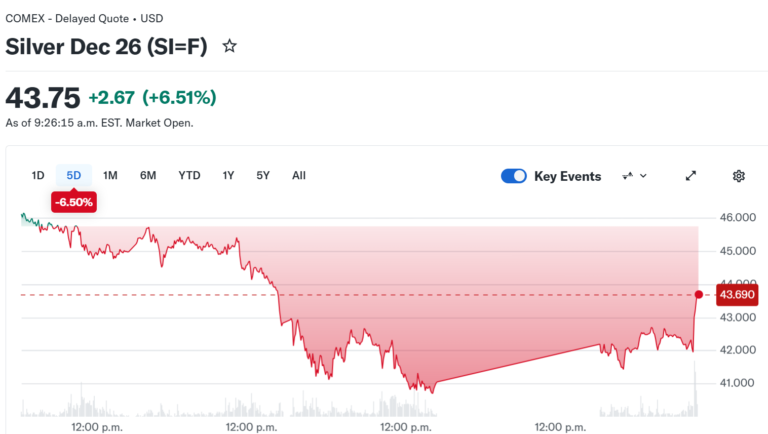
Silver futures closed at approximately US$41.07 per ounce, declining around 16.4% from the previous week’s close of approximately US$49.12. Silver significantly underperformed gold during the week. As both a precious and industrial metal, silver faced additional downside pressure from concerns about slowing global economic growth, weaker industrial demand expectations, and a stronger U.S. dollar.
Source: Yahoo Finance
Oil Market:
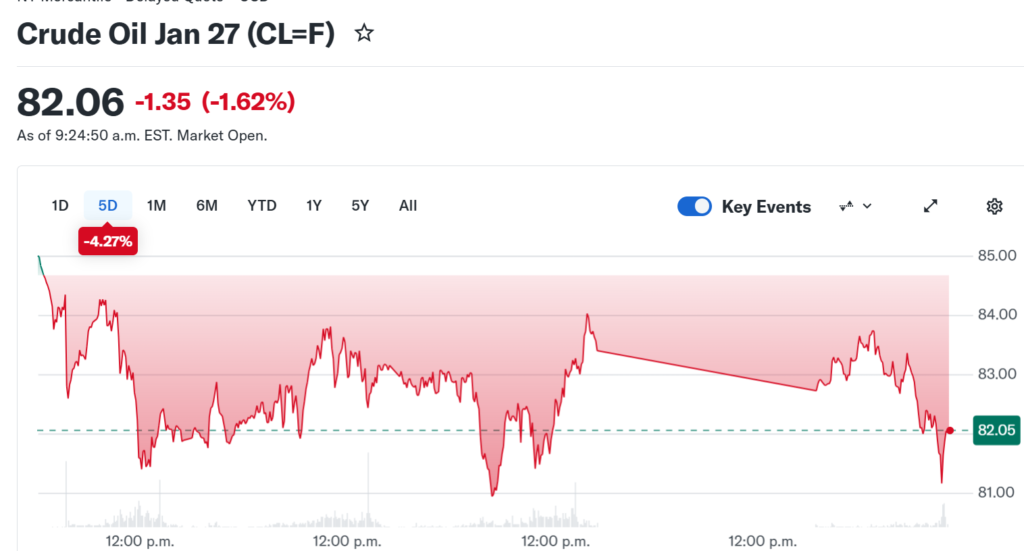
WTI crude oil futures closed at approximately US$83.41 per barrel, declining around 5.8% from the previous week’s close of approximately US$88.56. Uncertainty surrounding global economic growth and energy demand, combined with weaker overall risk sentiment, weighed on oil prices. However, ongoing geopolitical risks continued to provide some support to the energy market.
- Let us contact you
Investing with an AimStar's investment professional
Want expert advice at every step of your investing journey?
AimStar’s investment professionals can set you on the right course – and they can meet in-person or online.
Financial Market Data Copyright © 2026 AimStar myportfolio. Data as of November 24th, 2026, 15:30 PM EST

WHAT'S HAPPENING THIS WEEK
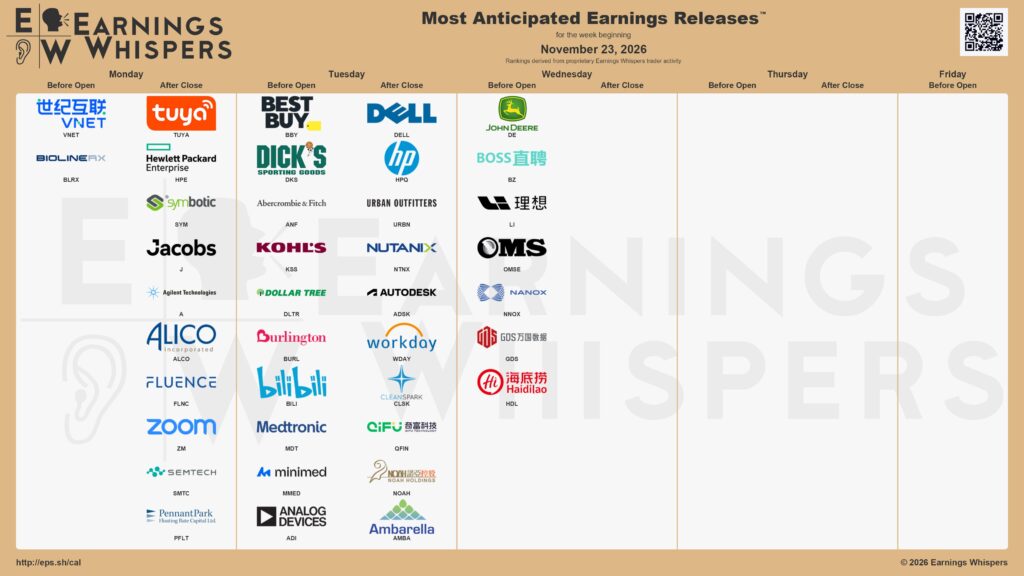
Upcoming Events This Week
Monday, November 23:
Economic Data & Events: U.S. November S&P Global Manufacturing PMI, Services PMI, and Composite PMI (Preliminary).
Key Earnings: VNET (VNET), BioLineRx, Hewlett Packard Enterprise, Tuya, Symbotic, Jacobs Solutions, Agilent Technologies, Zoom, Fluence Energy, Semtech, Alico.
Tuesday, November 24:
Economic Data & Events: U.S. September S&P/Case-Shiller Home Price Index, U.S. November Consumer Confidence Index, U.S. November Richmond Fed Manufacturing Index, Bank of Canada Governor Tiff Macklem’s remarks.
Key Earnings: Best Buy, Dick’s Sporting Goods, Abercrombie & Fitch, Kohl’s, Dollar Tree, Burlington Stores, Bilibili, Medtronic, Analog Devices, Dell Technologies, HP Inc., Urban Outfitters, Nutanix, Autodesk, Workday, Qifu Technology, Ambarella.
Wednesday, November 25:
Economic Data & Events: U.S. Q3 GDP (Second Estimate), U.S. October Personal Income and Spending, U.S. October PCE and Core PCE Price Index, U.S. October Durable Goods Orders, U.S. Initial Jobless Claims, U.S. October New Home Sales, Federal Reserve Beige Book.
Key Earnings: Deere & Company, Kanzhun (BOSS Zhipin), Li Auto, OMS Energy Technologies, Nano-X Imaging, GDS Holdings, Haidilao.
Thursday, November 26:
Economic Data & Events: U.S. Thanksgiving holiday; U.S. equity and bond markets closed. Japan’s November Tokyo CPI.
Friday, November 27:
Economic Data & Events: U.S. October Advance Goods Trade Balance, Canada’s Q3 Current Account Balance. U.S. equity markets close early at 1:00 p.m. ET.
Author by: Sarah San
Edited & Published by: Sarah San
November 24th , 2026 15:30 PM EST. 10 min read

AimStar Capital Group Inc. is a Canadian full-service Investment Dealer, regulated by Canadian Investment Regulatory Organization (CIRO) and a member of Canadian Investor Protection Fund (CIPF). As an independent firm, AimStar is built on a foundation of innovation, integrity, and client-centricity. They are committed to providing unbiased advice and dedicated to the client’s needs, helping them achieve their financial goals.
AimStar is recognized as a Wealth Professionals 5-star Wealth Management Firm for 2024, this award recognized AimStar has offered exceptional client experience, a proven investment track record, continuous innovation, and stringent regulatory compliance.