

Key Focus This Week:
“U.S. inflation and consumer data are once again driving interest rate expectations, while Canada’s real economy figures, tech earnings reports, and energy risks jointly influence the market.”
After the notable divergence in U.S. and Canadian employment data last week, this week’s focus in North American financial markets will shift back to inflation and consumer activity. The U.S. will release reports on consumer prices, producer prices, and retail sales—data that will help assess whether recent changes in energy costs, imports, and corporate expenses are spilling over into broader goods and services pricing, while also testing whether consumer spending can continue to support economic growth.
Meanwhile, a marked slowdown in U.S. job growth last week has dampened market expectations for further tightening by the Federal Reserve in the near term. However, the unemployment rate did not deteriorate in tandem, leaving mixed signals from the labor market. As a result, this week’s inflation data carries heightened importance: if price pressures remain sticky, the Fed may still have grounds to maintain a cautious or even tighter policy stance; if inflation continues to cool, it could ease market concerns about further rate hikes.
Middle East tensions remain a key source of uncertainty for markets this week. Iran and Oman have made some progress on shipping arrangements in the Strait of Hormuz, but full resumption of normal passage remains conditional and uncertain. Meanwhile, shipping routes in the Red Sea and surrounding areas continue to face security risks.
As such, oil prices may continue to fluctuate between hopes for diplomatic easing and lingering supply disruption risks. If shipping gradually resumes, falling energy prices could alleviate global inflation and bond yield pressures. Conversely, if negotiations stall again or military conflict escalates, oil prices could once more become a major driver of inflation expectations.
For Canada, rising energy prices typically support energy stocks and certain resource companies, but also increase inflationary pressure. A drop in oil prices could have the opposite effect. Therefore, the energy market is likely to remain a significant influence on both the Canadian stock market and the Canadian dollar this week.
Week’s Key Economic Data & News Recap
The US job market has clearly cooled, but the unemployment rate is sending conflicting signals.
Last week’s US jobs report showed that job growth was significantly weaker than previously expected, and earlier employment data was also revised downwards, indicating that overall hiring demand from businesses is cooling. Employment performance in some consumer and service sectors was particularly weak.
However, the US unemployment rate did not rise in tandem; instead, it declined, mainly due to changes in labor supply and labor participation. Therefore, last week’s jobs report cannot be simply interpreted as the US economy having entered a clear recession, but rather as the labor market entering a slow phase of “low hiring, low layoffs.”
Following the release of the jobs data, the market lowered its expectations for further tightening of monetary policy by the Federal Reserve in the near future, putting some pressure on US Treasury yields and the dollar, while supporting stock market sentiment.
Improved US productivity helps alleviate some labor cost pressures.
Last week’s US labor productivity report showed that the pace of improvement in business productivity has accelerated, while unit labor cost pressures have remained relatively moderate.
Improved productivity is particularly important for the current market. If businesses can improve output efficiency through artificial intelligence, automation, software, and other capital investments, even if wages continue to rise, it may not necessarily create the same level of inflationary pressure.
This trend also provides a longer-term economic logic for AI investment: the value of AI capital expenditure lies not only in the revenue growth of tech companies, but also in its potential to impact the US economy’s potential growth and inflation levels by boosting productivity across a wider range of industries. However, more data over a longer period is needed to determine whether this trend can be sustained.
Significant divisions remain within the Federal Reserve regarding further policy tightening.
Despite signs of a cooling job market, some Fed officials last week believed that inflation risks were not yet fully controlled and advocated for a tighter monetary policy.
Meanwhile, following the release of the jobs report, financial markets significantly reduced their expectations for near-term interest rate hikes. This indicates a continued divergence between the market and some Fed policymakers: the market is more focused on the economic and employment slowdown, while some policymakers are more concerned about inflation remaining above target for an extended period.
This divergence is why this week’s inflation report is so important. If price pressures remain significant, voices within the Fed supporting tighter policy may persist; if inflation cools in tandem, the importance of a weakening job market will increase significantly.
Corporate earnings remained generally strong, but AI-related stocks experienced significantly increased volatility.
Last week, US corporate earnings generally continued to support the stock market, with artificial intelligence, cloud computing, and semiconductors remaining among the main growth themes. Strong earnings performance helped major US stock indices approach or reach new highs.
However, the divergence within AI-related stocks has widened significantly. Investors are increasingly focusing on whether companies can translate their increasing AI capital expenditures into actual profits and cash flow, rather than simply assigning higher valuations based on revenue growth or AI-related orders.
Therefore, last week the market continued a new trend emerging in recent weeks: the AI theme itself remains recognized, but the market is no longer indiscriminately chasing all AI-related companies; the importance of earnings quality, valuation, and return on capital has increased significantly.
US stocks remained high, driven by strong earnings reports and weak employment data
US stocks performed strongly overall last week, with the technology and semiconductor sectors continuing to provide significant support. Weaker employment data reduced market concerns about near-term interest rate hikes, while overall corporate earnings remained strong, both factors supporting risk assets.
However, the market is currently more sensitive to macroeconomic data. With stock indices at high levels and technology stock valuations high, the stock market could be more volatile if inflation strengthens again or bond yields rise significantly. Therefore, this week’s US inflation report will be one of the key events to test whether the recent stock market rally can be sustained.
Investing with an AimStar's investment professional
Want expert advice at every step of your investing journey?
AimStar’s investment professionals can set you on the right course – and they can meet in-person or online.

Market Performance Review – Last Week
Source: Yahoo Finance
Canadian Equities:
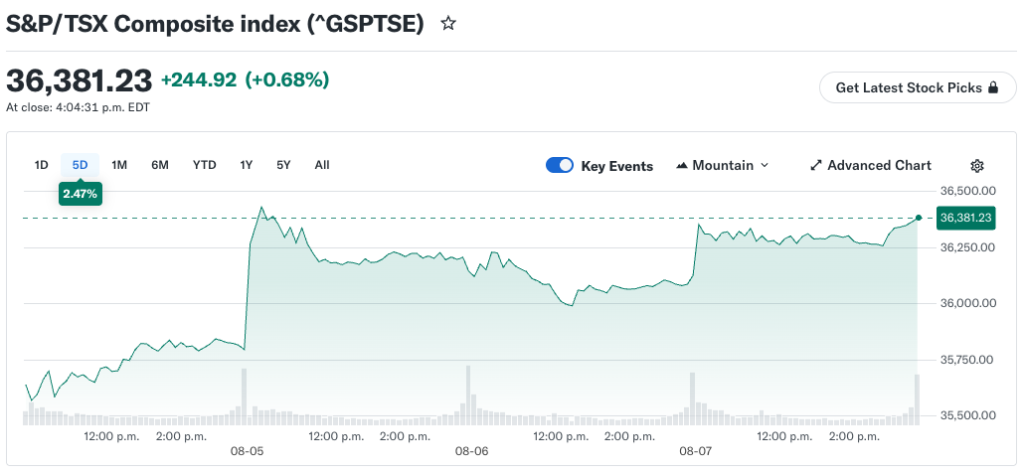
Last week, the S&P/TSX Composite Index showed a strong upward trend, fluctuating higher within the 35,000–36,400 range and setting a new closing record on Friday. The index rose approximately 3.3% for the week, its strongest week in nearly four months, ultimately closing at 36,381.20.
Source: Yahoo Finance
U.S. Equities:
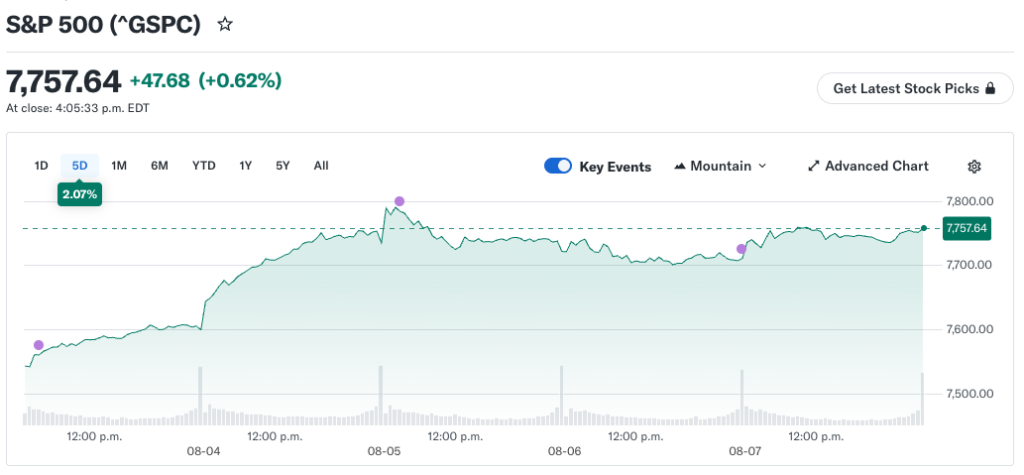
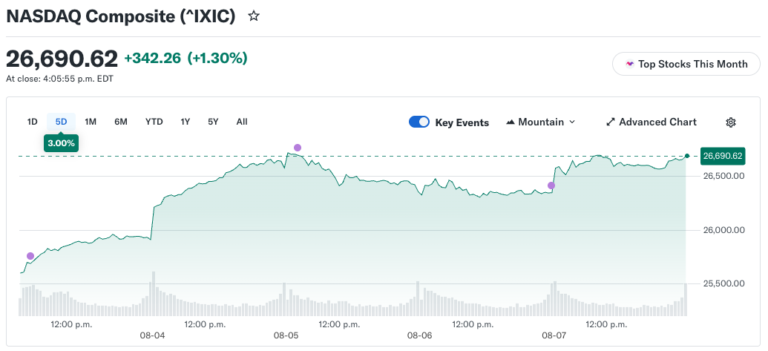
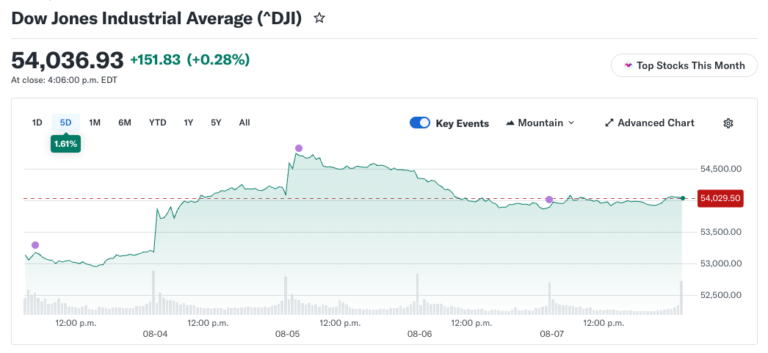
Last week, the three major U.S. stock indexes performed strongly overall, with the market rising steadily driven by solid earnings from large-cap technology stocks and improved market risk appetite, as well as changes in interest rate expectations. The S&P 500 Index remained largely within the 7,550.00 – 7,800.00 range, rising 2.07% over five days to close at 7,757.64; the NASDAQ Composite traded within the approximately 25,500.00 – 26,700.00 range, rising 3.00% over five days to close at 26,690.62; and the Dow Jones Industrial Average remained within the approximately 52,900 – 54,700 range, rising 1.61% over five days to close at 54,036.93.
Source: Yahoo Finance
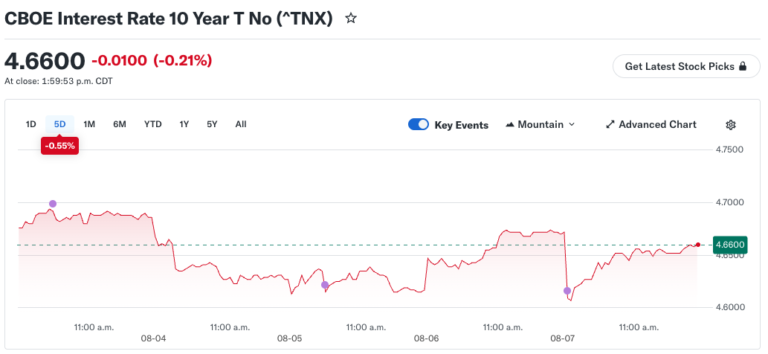
U.S. Bonds:
Last week, the yield on the 10-year U.S. Treasury note (CBOE Interest Rate 10 Year T Note, ^TNX) remained high, fluctuating between 4.59% and 4.74%, and fell by about 0.6% over five days, closing at 4.66%. The yield briefly rose to around 4.67% during the week before falling back due to weaker-than-expected U.S. July jobs data and a cooling of market expectations for a September rate hike by the Federal Reserve.
Source: Yahoo Finance
Forex Market:
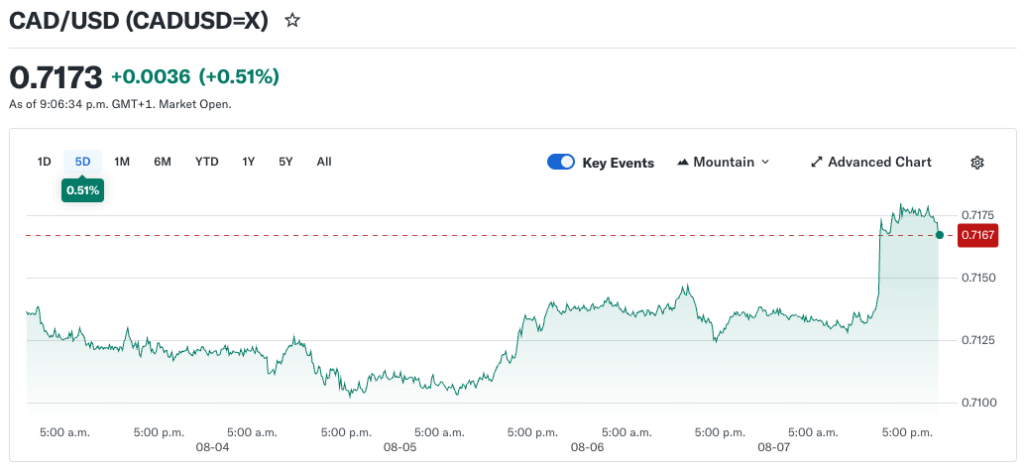
Last week, the Canadian dollar (CAD/USD) exhibited a generally weak-to-strong, volatile rebound. The exchange rate initially fell from around 0.7135 to around 0.7105 before rebounding rapidly, reaching a recent high of around 0.7175 on Friday. It accumulated a gain of approximately 0.51% over five days, closing near 0.7173. Overall, the Canadian dollar stabilized significantly in the middle of the week after initial pressure, and broke through the 0.715 level at the end of the week, indicating a short-term improvement in its trend.
Source: Yahoo Finance
Gold & Silver Market:
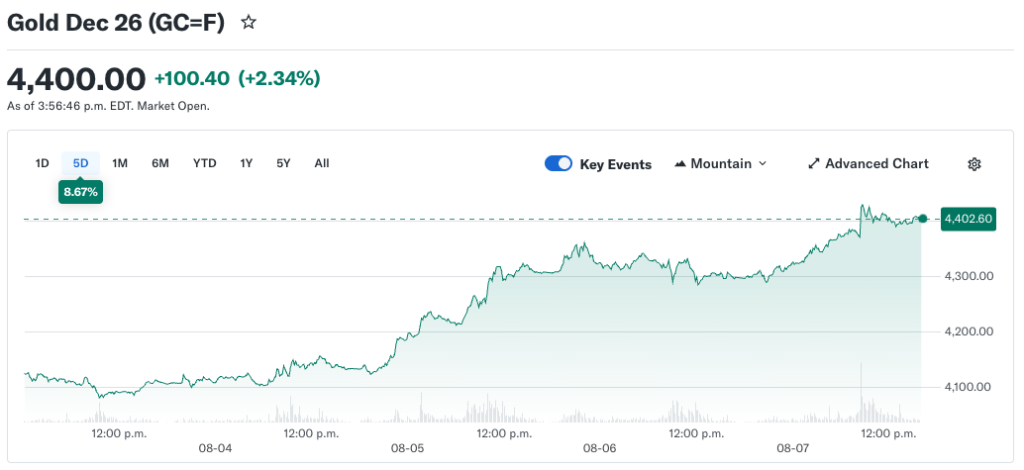
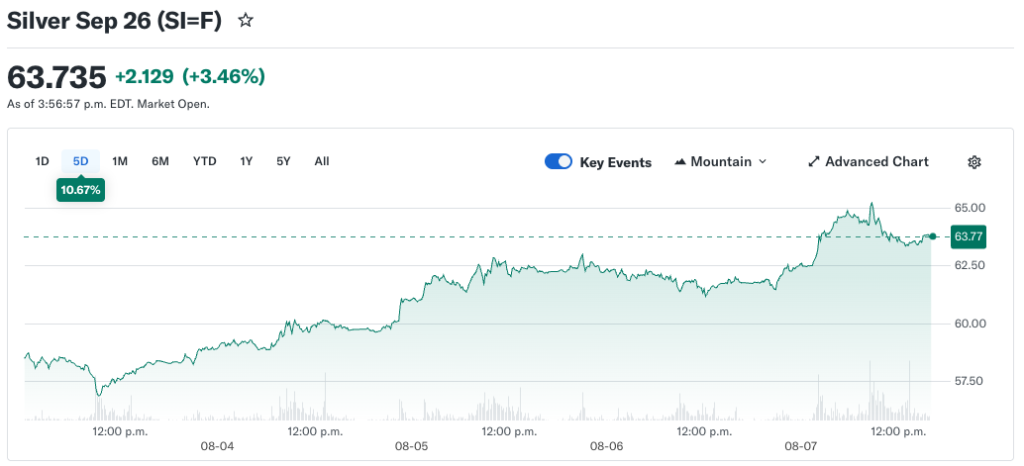
Last week, the gold and silver markets saw a strong rebound, with precious metals showing significant strength after a period of correction. Gold rose approximately 7.2% during the week, marking its largest weekly gain since January, reaching around $4,400 per ounce on Friday. Silver performed even stronger, with a weekly gain of nearly 10%, briefly breaking through $65 per ounce on Friday before closing at around $63.3 per ounce.
Source: Yahoo Finance
Oil Market:
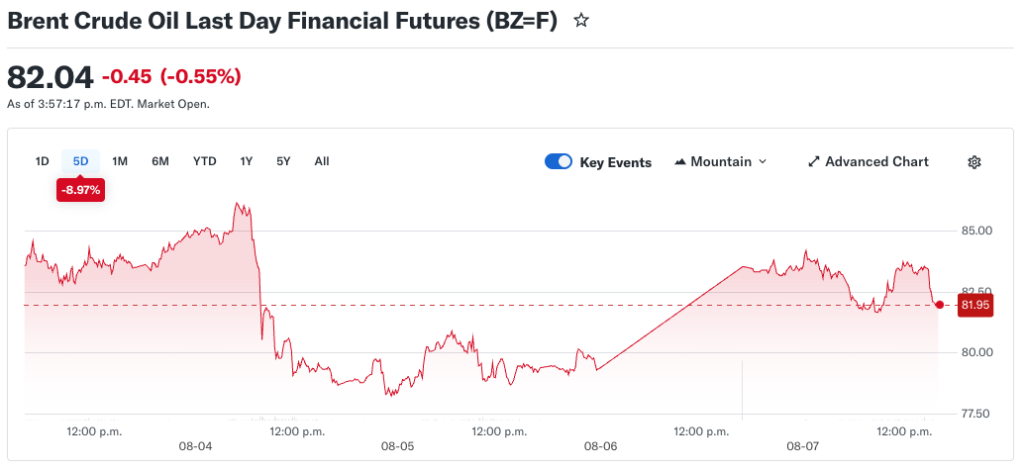
Last week, Brent crude oil futures experienced a sharp decline followed by a rebound, with significantly increased volatility. Brent initially traded around $86-87 per barrel, but prices quickly fell due to rising market expectations of a potential agreement between the US and Iran and the reopening of the Strait of Hormuz, dropping to around $79 per barrel mid-week. Subsequently, as the market reassessed the uncertainty surrounding the implementation of the agreement and the continued shipping risks in the Strait of Hormuz, prices rebounded significantly on Thursday and Friday, closing at $82.04 per barrel on Friday, a daily increase of approximately 1.3%, but still down about 5% for the week.
- Let us contact you
Investing with an AimStar's investment professional
Want expert advice at every step of your investing journey?
AimStar’s investment professionals can set you on the right course – and they can meet in-person or online.
Financial Market Data Copyright © 2026 AimStar myportfolio. Data as of August 10th, 2026, 12:30 PM EST

WHAT'S HAPPENING THIS WEEK

Upcoming Events (August 3 – August 7, 2026)
August 10 (Monday)
Pre-market: Roivant Sciences (ROIV), Legend Biotech (LEGN), monday.com (MNDY), Perion Network (PERI), Axsome Therapeutics (AXSM), Hims & Hers Health (HIMS), Soho China (SOHU), and others will release earnings reports.
After-market: Rocket Lab (RKLB), AST SpaceMobile (ASTS), Simon Property Group (SPG), Take-Two Interactive (TTWO), Upwork (UPWK), GoPro (GPRO), Harrow (HROW), Rapid7 (RPD), Getty Images (GETY), and others will release earnings reports. Rocket Lab has confirmed that it will release its Q2 earnings report after the US stock market closes on August 10; AST SpaceMobile is also scheduled to release its Q2 results on the same day.
August 11 (Tuesday)
Pre-market: CoreWeave (CRWV), Cardinal Health (CAH), and others will release earnings reports.
After-market: Lumentum (LITE), CoreWeave (CRWV), Super Micro Computer (SMCI), Plug Power (PLUG), USA Rare Earth (USAR), BigBear.ai (BBAI), and others will release earnings reports.
SMCI, CRWV, and LITE are among the most noteworthy companies in the AI infrastructure sector this week. Lumentum has confirmed its earnings release after market close on August 11th, while CoreWeave has scheduled an earnings call at 5:00 p.m. ET that day.
August 12th (Wednesday)
Pre-market: Nebius (NBIS), Beta Technologies (BETA), and others will release earnings reports.
After-market: Cisco Systems (CSCO), Coherent (COHR), Celsius Holdings (CELH), Cava Group (CAVA), and others will release earnings reports.
NBIS is one of the most watched AI companies this week. Nebius has officially confirmed that it will release its Q2 earnings report before the market opens on August 12th; Cisco has confirmed that it will release its FY2026 Q4 results after the US stock market closes on the same day.
August 13th (Thursday)
Pre-market: JD.com, Ross Stores (ROST), Workhorse Group (WKHS), etc., will release earnings reports.
After-market: Applied Materials (AMAT), StoneCo (STNE), etc., will release earnings reports.
August 14 (Friday)
Before Market Open: RLX Technology (RLX), Super League Enterprise (SLE), Sigma Lithium (SGML), Cellebrite (CLBT), VerticalScope Holdings (FORA), Outlook Therapeutics (OTLK), LanzaTech Global (LNZA), Gemini Space Station (GEMI), Lantern Pharma (LTRN), Credicorp (BAP), ImmuCell (ICCM), Lifeward (LFWD), and others will release earnings reports.
After Market Close: Duos Technologies Group (DUOT), Barfresh Food Group (BRFH), TOMI Environmental Solutions (TOMZ), Sidus Space (SIDU), Motorsport Games (MSGM), Milestone Scientific (MLSS), and others will release earnings report
Author by: Sarah San
Edited & Published by: Sarah San
August 10th , 2026 13:00 PM EST. 10 min read

AimStar Capital Group Inc. is a Canadian full-service Investment Dealer, regulated by Canadian Investment Regulatory Organization (CIRO) and a member of Canadian Investor Protection Fund (CIPF). As an independent firm, AimStar is built on a foundation of innovation, integrity, and client-centricity. They are committed to providing unbiased advice and dedicated to the client’s needs, helping them achieve their financial goals.
AimStar is recognized as a Wealth Professionals 5-star Wealth Management Firm for 2024, this award recognized AimStar has offered exceptional client experience, a proven investment track record, continuous innovation, and stringent regulatory compliance.