

Key Focus This Week: “Market Attention Turns to Inflation Data and Major Technology Earnings”
Market participants will closely monitor a series of U.S. economic indicators this week, particularly fresh data on inflation, housing activity, and consumer sentiment. The February Consumer Price Index (CPI) will be a key release, as investors continue to evaluate whether inflation pressures are easing or remaining persistent. Inflation data plays a crucial role in shaping expectations for monetary policy, and the latest figures could influence market views on the future path of interest rates.
Additional economic indicators scheduled for release include updates on the U.S. housing market and consumer sentiment. Housing data will provide insight into the impact of higher borrowing costs on real estate activity, while consumer sentiment surveys may offer signals about household confidence and spending behavior. Together, these indicators will help investors assess the broader trajectory of economic growth.
Corporate earnings will also be a focal point for markets during the week. Major technology companies Oracle and Adobe are among the most closely watched companies scheduled to report results. Investors will pay particular attention to commentary on cloud computing demand, enterprise software spending, and artificial intelligence initiatives, which have been key drivers of technology sector performance.
Meanwhile, developments in energy markets and geopolitical tensions will remain important factors influencing investor sentiment. Following last week’s sharp rise in oil prices, markets will continue to monitor geopolitical developments and their potential implications for global energy supply and inflation.
Last Week’s Key Economic Data & News Recap
Geopolitical Developments and Rising Oil Prices Influence Global Markets
Geopolitical developments remained a major driver of market sentiment during the week. Escalating tensions in the Middle East renewed concerns about potential disruptions to global energy supply, particularly around key shipping routes such as the Strait of Hormuz, a critical passage through which a large share of global seaborne oil exports passes. Reports of intensifying regional conflict heightened fears that energy supply chains could be affected, prompting a sharp increase in crude oil prices.
Oil prices surged during the week as investors reacted to the heightened geopolitical risks. According to market reports cited by financial media including Investopedia and Yahoo Finance, the rise in oil prices raised concerns among investors that higher energy costs could place renewed upward pressure on inflation. Energy prices play a key role in transportation and production costs across the global economy, meaning sustained increases can feed through into broader consumer prices.
The increase in oil prices also influenced financial markets more broadly. Rising energy costs contributed to increased volatility in global equity markets as investors reassessed the potential economic impact of higher input costs and geopolitical uncertainty. At the same time, higher oil prices can influence expectations about the future path of inflation and monetary policy, highlighting the continued sensitivity of global markets to geopolitical developments affecting energy supply.
U.S. Economic Indicators Provide Insight into Labor Market and Economic Momentum
Economic data released during the week provided additional insight into the health of the U.S. economy, with particular attention focused on the February employment report and activity indicators from the services sector.
According to data from the U.S. Bureau of Labor Statistics, the February employment report showed a moderation in labor market conditions. Nonfarm payroll employment declined by 92,000 jobs during the month, while the unemployment rate stood at 4.4%. The data surprised some market participants who had expected modest job growth, suggesting that hiring momentum may be slowing after a period of sustained labor market strength. Despite the decline in employment, wage growth remained relatively firm, indicating that wage pressures in the labor market have not fully eased.
Additional economic indicators released during the week also provided signals regarding broader economic activity. The ISM Services Purchasing Managers’ Index remained above the 50 level, indicating continued expansion in the services sector, which accounts for the largest share of U.S. economic output. However, businesses continued to report elevated cost pressures, a factor that investors are closely monitoring in assessing the outlook for inflation.
Together, these economic indicators highlighted the mixed signals currently emerging from the U.S. economy. While parts of the economy continue to show resilience, softer labor market data may indicate that economic momentum is gradually moderating. As a result, investors continue to evaluate how incoming data may influence the outlook for growth, inflation, and future monetary policy decisions.
Global Markets React to Rising Energy Prices and Shifting Interest Rate Expectations
Financial markets experienced increased volatility during the week as investors reacted to both rising energy prices and new economic data. Major U.S. equity indices, including the S&P 500, Dow Jones Industrial Average, and Nasdaq Composite, faced downward pressure as concerns about inflation and geopolitical risks weighed on investor sentiment. Several daily market summaries reported that the surge in oil prices contributed to declines in equity markets as investors reassessed the broader economic outlook.
Energy markets remained a key focus throughout the week. The sharp rise in crude oil prices supported energy-related stocks but created challenges for sectors sensitive to fuel costs, such as transportation and airline companies. The increase in energy prices also contributed to renewed attention on inflation risks across financial markets.
Bond markets reflected similar concerns. As oil prices climbed, investors reassessed the potential impact on inflation and the future path of interest rates, contributing to movements in U.S. Treasury yields. Higher yields can tighten financial conditions and influence equity valuations, which partly explains the cautious tone seen across global markets during the week.
Overall, the combination of geopolitical developments, rising energy prices, and mixed economic data contributed to a more cautious market environment, with investors closely monitoring how these factors may shape the outlook for inflation, economic growth, and monetary policy in the months ahead.
Investing with an AimStar's investment professional
Want expert advice at every step of your investing journey?
AimStar’s investment professionals can set you on the right course – and they can meet in-person or online.

Market Performance Review – Last Week
Source: Yahoo Finance
Canadian Equities:
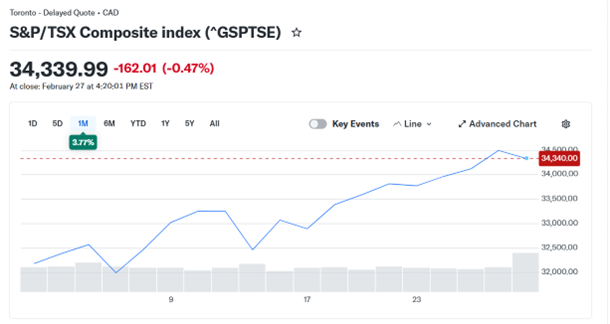
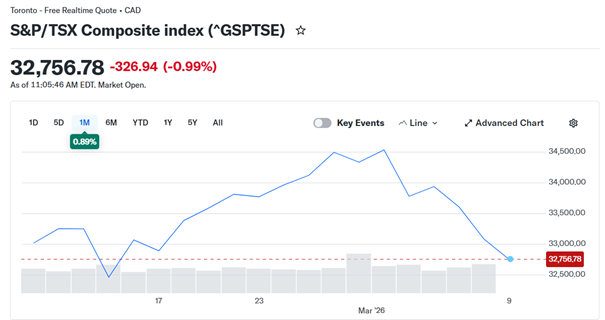
Canadian equities declined during the week as rising energy prices and geopolitical tensions weighed on market sentiment. The S&P/TSX Composite Index closed at 33,083.7 on Friday, reflecting pressure across several sectors as investors remained cautious amid increased market volatility.
Source: Yahoo Finance
U.S. Equities:
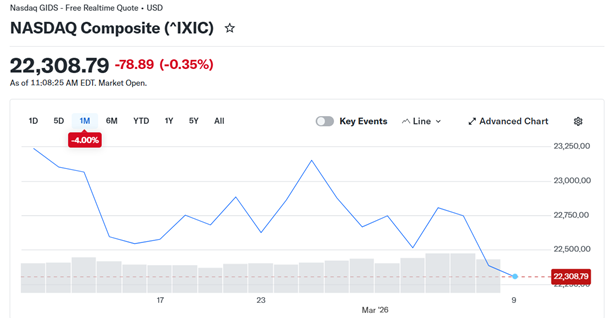
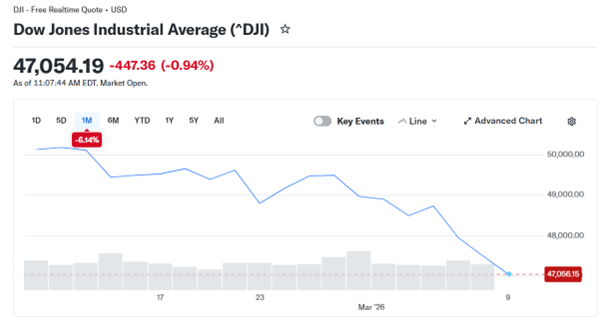
U.S. equity markets also faced downward pressure during the week. The S&P 500 closed at 6,740.02, while the Dow Jones Industrial Average ended the week at 47,501.55. The Nasdaq Composite closed at 22,387.68.
Investor sentiment remained cautious as rising oil prices and geopolitical risks increased concerns about inflation and the potential impact on global economic growth.
Source: Yahoo Finance
U.S. Bonds:
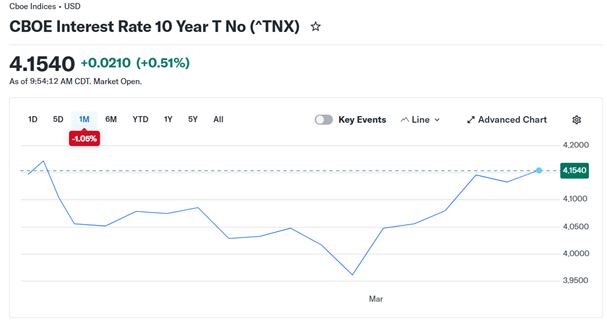
The U.S. Treasury market reflected shifting expectations regarding inflation and interest rates. The yield on the 10-year U.S. Treasury note closed at 4.133%, as investors monitored economic data and developments in energy markets that could influence inflation expectations.
Source: Yahoo Finance
Forex Market:
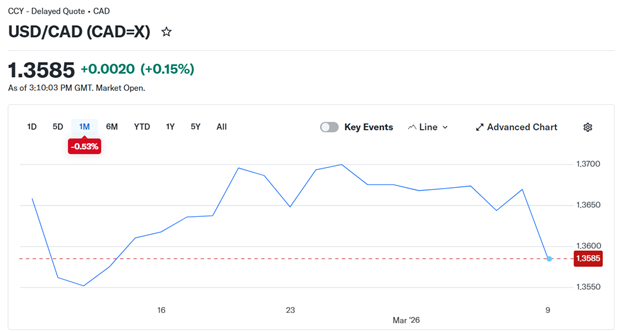
In the foreign exchange market, the U.S. dollar strengthened modestly against the Canadian dollar during the week. The USD/CAD exchange rate closed at 1.367, reflecting ongoing movements in commodity prices and global risk sentiment.
Source: Yahoo Finance
Gold Market& Silver Market:
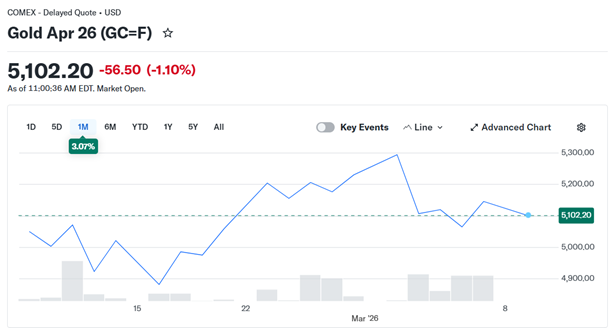
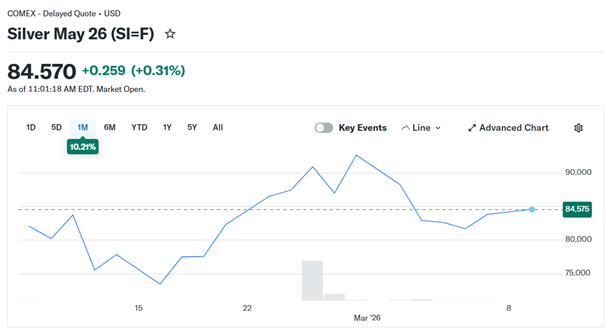
Precious metals prices moved higher during the week amid rising geopolitical tensions and increased demand for safe-haven assets. Gold closed at $5,146.1 per ounce, while silver ended the week at $83.816 per ounce, supported by investor demand for assets perceived as hedges against uncertainty and inflation.
Source: Yahoo Finance
Oil Market:
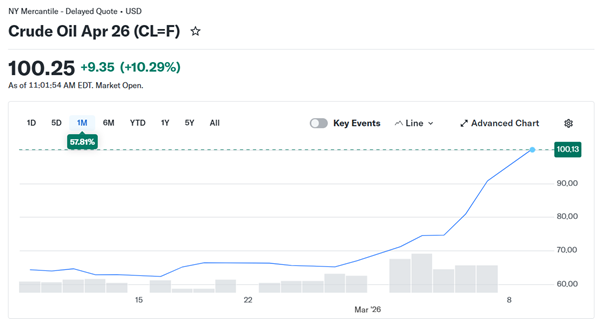
Crude oil prices rose sharply during the week as geopolitical developments heightened concerns about global supply risks. WTI crude oil futures closed at $90.9 per barrel, reflecting strong upward momentum in energy markets and growing attention to potential disruptions in global oil supply.
- Let us contact you
Investing with an AimStar's investment professional
Want expert advice at every step of your investing journey?
AimStar’s investment professionals can set you on the right course – and they can meet in-person or online.
Financial Market Data Copyright © 2026 AimStar myportfolio. Data as of March 9 , 2026, 12:30 PM EST

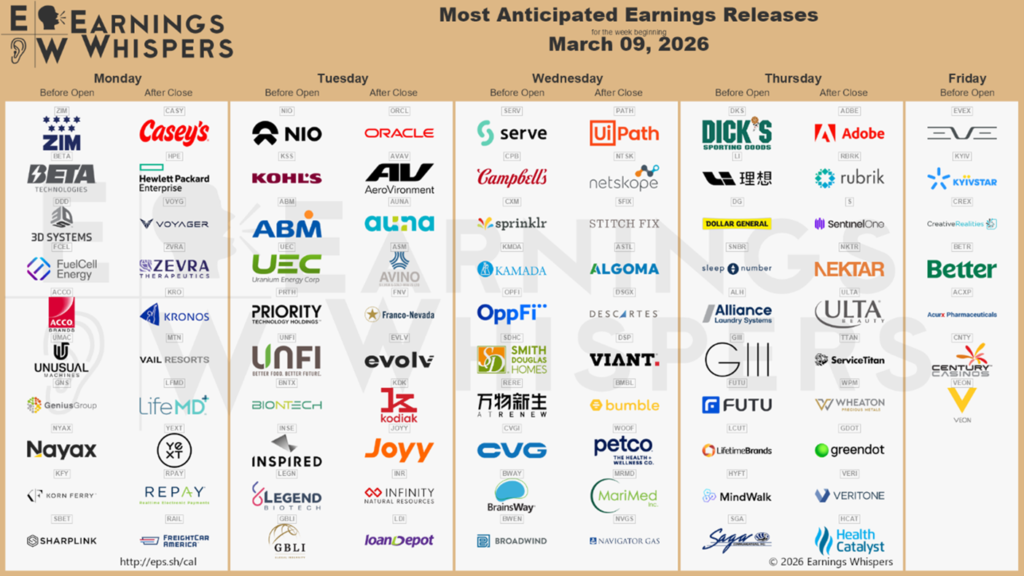
WHAT'S HAPPENING THIS WEEK
March 9 (Monday)
- Key Earnings: Casey’s General Stores.
March 10 (Tuesday)
- Economic Data & Events: Existing Home Saled (Feb).
- Key Earnings: Oracle, NIO, Franco-Nevada.
March 11 (Wednesday)
- Economic Data & Events: U.S. Core CPI (Feb).
- Key Earnings: UiPath.
March 12 (Thursday)
- Economic Data & Events: Initial Jobless Claims (March 7).
- Key Earnings: Adobe, Li Auto.
March 13 (Friday)
- Economic Data & Events: U.S. GDP (Q4), U.S. Core PCE Index (Jan).
- Key Earnings: Evexia Diagnostics.
Author by: Sarah San
Edited & Published by: Sarah San
March 9 , 2026 13:00 AM EST. 10 min read

AimStar Capital Group Inc. is a Canadian full-service Investment Dealer, regulated by Canadian Investment Regulatory Organization (CIRO) and a member of Canadian Investor Protection Fund (CIPF). As an independent firm, AimStar is built on a foundation of innovation, integrity, and client-centricity. They are committed to providing unbiased advice and dedicated to the client’s needs, helping them achieve their financial goals.
AimStar is recognized as a Wealth Professionals 5-star Wealth Management Firm for 2024, this award recognized AimStar has offered exceptional client experience, a proven investment track record, continuous innovation, and stringent regulatory compliance.