

Key Focus This Week: “Market Attention Turns to Federal Reserve Decision, Economic Data, and Key Corporate Earnings”
Investors will focus primarily on the U.S. Federal Reserve’s March policy meeting, which concludes Wednesday with an interest-rate decision and a press conference by Chair Jerome Powell. The Fed is widely expected to keep its benchmark interest rate unchanged, but markets will closely analyze Powell’s remarks and updated economic projections for signals about the timing of potential rate cuts later this year. Investors are particularly interested in how policymakers assess recent inflation trends and whether tightening financial conditions could influence the policy outlook.
Alongside the policy decision, markets will also monitor several economic indicators that could shape expectations for monetary policy. February U.S. retail sales data, released Tuesday, will provide insight into the strength of consumer spending after recent signs of slowing demand. Meanwhile, U.S. industrial production and housing market data will offer additional signals on the health of the broader economy. These indicators may influence how investors interpret the Fed’s policy stance and the trajectory of economic growth in the coming months.
Corporate earnings will also attract attention, particularly from companies whose results may provide signals about key sectors of the economy. Micron Technology, reporting Wednesday, will be closely watched for updates on demand in the semiconductor industry and the outlook for artificial intelligence-related spending. On Thursday, FedEx and Accenture are scheduled to release earnings, offering insights into global trade activity, logistics demand, and corporate technology spending. Together, these reports may help investors assess whether economic momentum remains resilient despite rising geopolitical risks and financial-market volatility.
Last Week’s Key Economic Data & News Recap
Geopolitical Developments and Oil Prices Remained the Main Drivers of Market Sentiment
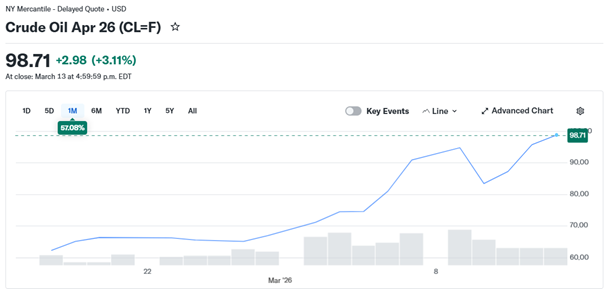
Geopolitical tensions in the Middle East continued to dominate global market sentiment last week. Concerns over disruptions to energy supply, particularly around the Strait of Hormuz, pushed oil prices sharply higher and renewed worries about inflationary pressure across major economies. Reuters reported that oil and gas prices have risen significantly since the conflict escalated, prompting investors to reassess the outlook for central bank policy and global growth. By the end of the week, WTI crude settled at $98.71 per barrel and Brent crude finished above $103, underscoring how sensitive financial markets remain to energy supply risk.
The rise in oil prices had broader macroeconomic implications. Higher energy costs increased concern that inflation could remain elevated for longer, even as some underlying economic data showed cooling activity. Financial markets responded by reducing expectations for near-term Federal Reserve rate cuts, while analysts increasingly discussed the risk that a sustained energy shock could complicate the policy outlook by weakening growth and lifting inflation at the same time.
Economic Data Highlighted a Mixed Picture for the U.S. and Canadian Economies
In the United States, February consumer price data showed inflation remained steady before the full effects of the recent oil shock were reflected in the numbers. Reuters reported that CPI rose 0.3% on the month and held at 2.4% year over year, while core CPI increased 0.2% on the month. At the same time, January core PCE, the Fed’s preferred inflation gauge, rose 3.1% year over year, suggesting that underlying inflation pressures were still firm even before energy markets tightened further.
Growth and sentiment indicators pointed to a softer economic backdrop. U.S. fourth-quarter GDP growth was revised down to an annualized 0.7%, reflecting weaker consumer spending and investment than previously estimated. Consumer sentiment also deteriorated in early March, with the University of Michigan index falling to 55.5 from 56.6 in February as rising gasoline prices and geopolitical uncertainty weighed on household confidence.
In Canada, labor-market data surprised sharply to the downside. Reuters reported that the Canadian economy lost 83,900 jobs in February and the unemployment rate rose to 6.7%, a much weaker result than expected. That report contributed to pressure on the Canadian dollar and added to concern about domestic growth momentum, even as higher oil prices provided some support for the country’s energy sector.
Financial Markets Reflected Rising Caution as Investors Repriced Inflation and Growth Risks
Equity markets moved lower through much of last week as investors weighed geopolitical risks, higher oil prices, and softer macroeconomic data. U.S. equities posted a third consecutive weekly decline, while Canada’s TSX fell to a one-month low on Friday. Bond yields moved higher as markets reassessed inflation risks, and the U.S. dollar strengthened against the Canadian dollar as investors sought relative safety. Gold, which had been supported earlier by safe-haven demand, still finished the week lower as the stronger dollar and higher rate expectations reduced its near-term appeal.
Investing with an AimStar's investment professional
Want expert advice at every step of your investing journey?
AimStar’s investment professionals can set you on the right course – and they can meet in-person or online.

Market Performance Review – Last Week
Source: Yahoo Finance
Canadian Equities:
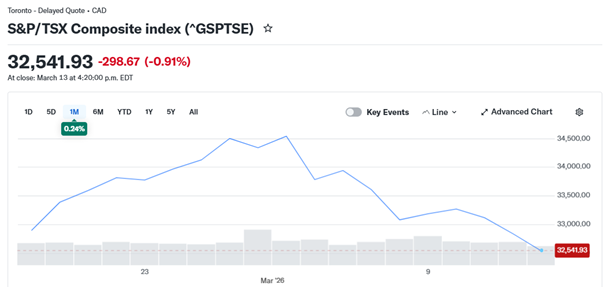
Canadian equities declined over the week amid geopolitical uncertainty and weaker domestic economic data. The S&P/TSX Composite Index closed at 32,541.93 on Friday, down 298.67 points (-0.91%) on the day. The decline reflected broad risk-off sentiment across global markets, although strength in the energy sector helped partially offset losses as crude oil prices continued to rise.
Source: Yahoo Finance
U.S. Equities:
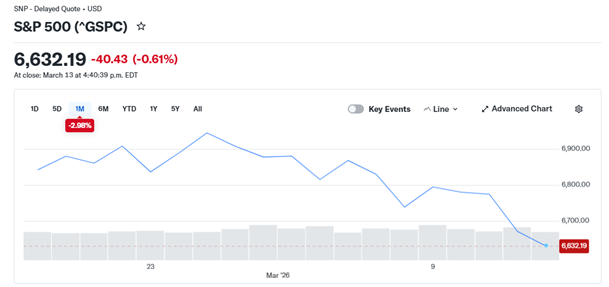
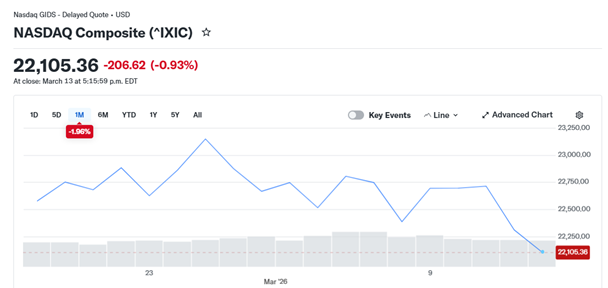
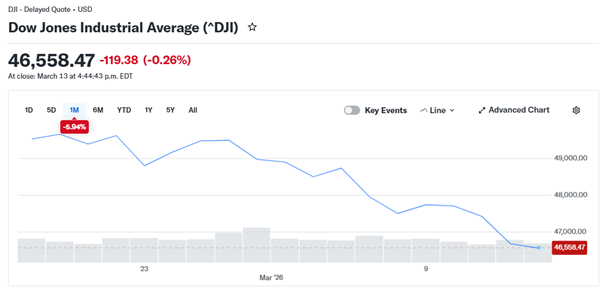
U.S. equity markets also ended the week lower as investors weighed geopolitical risks and the potential inflationary effects of rising energy prices. On Friday, the S&P 500 closed at 6,632.19 (-0.61%), the Dow Jones Industrial Average finished at 46,558.47 (-0.26%), and the Nasdaq Composite ended at 22,105.36 (-0.93%).
Source: Yahoo Finance
U.S. Bonds:
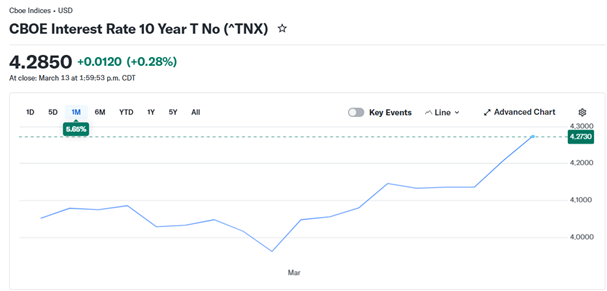
U.S. Treasury yields moved higher during the week as investors reassessed inflation expectations and the outlook for monetary policy. The 10-year U.S. Treasury yield closed at approximately 4.285% on Friday, reflecting expectations that interest rates may remain elevated for longer given recent developments in energy markets.
Source: Yahoo Finance
Forex Market:
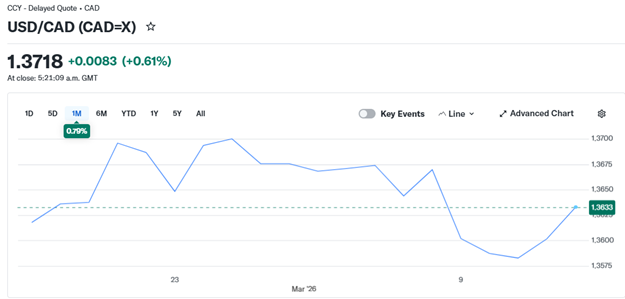
In foreign exchange markets, the U.S. dollar strengthened against the Canadian dollar as investors responded to weaker Canadian economic data and a shift toward safe-haven assets. The USD/CAD exchange rate closed around 1.3718 on Friday, representing a modest weekly gain for the U.S. dollar.
Source: Yahoo Finance
Gold Market& Silver Market:
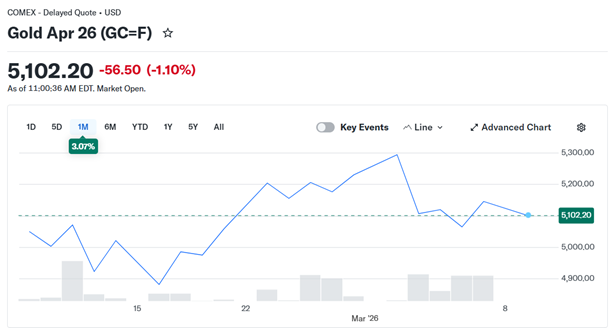
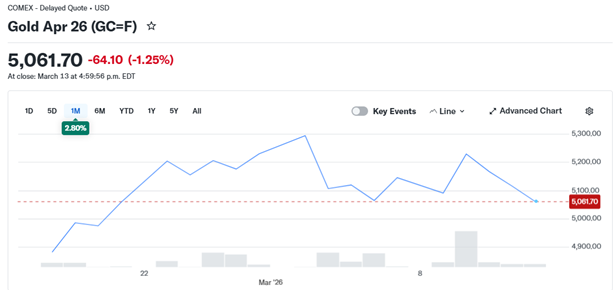
Precious metals declined by the end of the week despite ongoing geopolitical tensions. Gold futures closed at $5,061.70 per ounce, while silver futures finished at $81.343 per ounce. The pullback was partly driven by a stronger U.S. dollar and rising Treasury yields, which tend to weigh on non-yielding assets such as gold.
Source: Yahoo Finance
Oil Market:
Crude oil prices continued to rise during the week amid concerns over potential supply disruptions in the Middle East. WTI crude oil closed at $98.71 per barrel on Friday, up roughly 3.11% on the day, as markets remained sensitive to geopolitical developments affecting global energy supply.
- Let us contact you
Investing with an AimStar's investment professional
Want expert advice at every step of your investing journey?
AimStar’s investment professionals can set you on the right course – and they can meet in-person or online.
Financial Market Data Copyright © 2026 AimStar myportfolio. Data as of March 16 , 2026, 12:30 PM EST

WHAT'S HAPPENING THIS WEEK
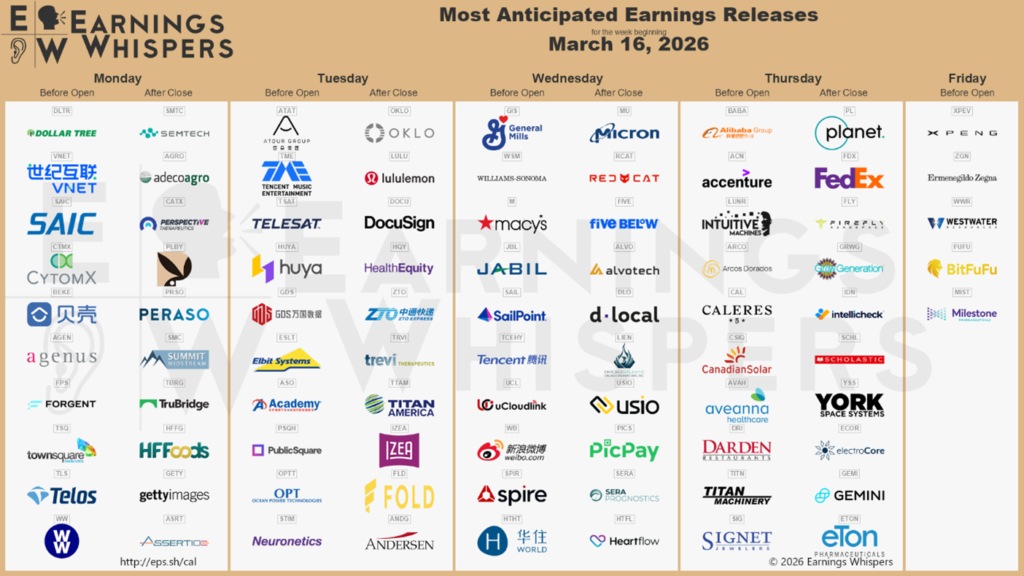
March 16 (Monday)
- Economic Data & Events: Canada CPI (Feb), U.S. industrial production (Feb).
- Key Earnings: Dollar Tree.
March 17 (Tuesday)
- Key Earnings: lululemon.
March 18 (Wednesday)
- Economic Data & Events: U.S. Producer Price Index (Feb), U.S. Federal Reserve Interest Rate Decision. Canada BoC Interest Rate Decision, Euro Zone CPI (Feb)
- Key Earnings: Micron Technology.
March 19 (Thursday)
- Economic Data & Events: U.S. Initial Jobless Claims.
- Key Earnings: Accenture, FedEx.
March 20 (Friday)
- Economic Data & Events: Canada Retail Sales (Jan).
- Key Earnings: XPeng.
Author by: Sarah San
Edited & Published by: Sarah San
March 16 , 2026 13:00 AM EST. 10 min read

AimStar Capital Group Inc. is a Canadian full-service Investment Dealer, regulated by Canadian Investment Regulatory Organization (CIRO) and a member of Canadian Investor Protection Fund (CIPF). As an independent firm, AimStar is built on a foundation of innovation, integrity, and client-centricity. They are committed to providing unbiased advice and dedicated to the client’s needs, helping them achieve their financial goals.
AimStar is recognized as a Wealth Professionals 5-star Wealth Management Firm for 2024, this award recognized AimStar has offered exceptional client experience, a proven investment track record, continuous innovation, and stringent regulatory compliance.